Model year record
2023 Chevrolet Bolt EUV recalls & problems
The 2023 Chevrolet Bolt EUV has no safety recalls on file with NHTSA, and 119 owner complaints. The most-reported problem area is forward collision avoidance (42 complaints).
Safety recalls
No safety recalls have been filed for the 2023 Chevrolet Bolt EUV.
Recall repairs are free at any authorised dealer. A recall listed here may already have been fixed on a particular car: enter its 17-character VIN at nhtsa.gov/recalls to see open recalls.
Crash test ratings
2023 Chevrolet Bolt EUV SUV FWD
| Frontal crash | ★★★★★ |
|---|---|
| Side crash | ★★★★★ |
| Rollover | ★★★★★ |
| Rollover risk | 10.7% |
Forward collision warning: Standard & Optional · Lane departure warning: Standard & Optional
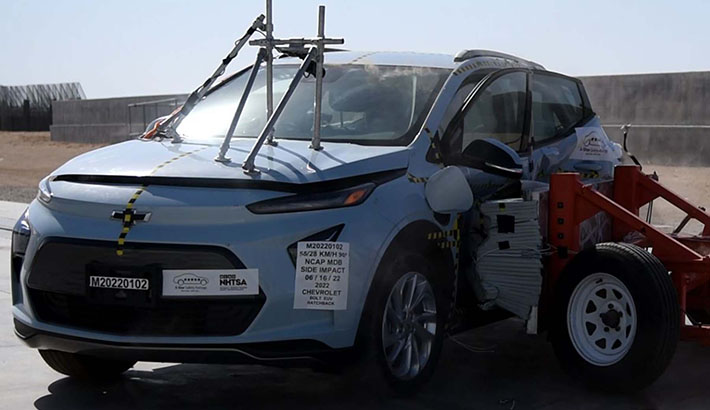
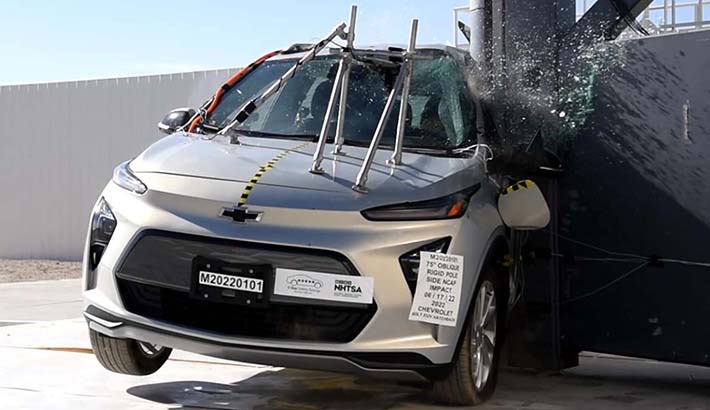
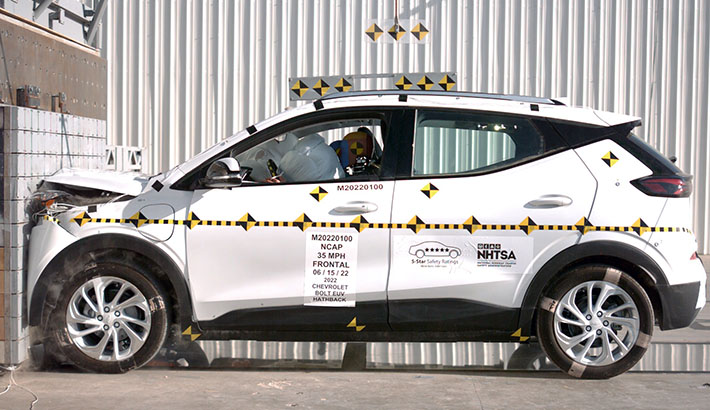
NHTSA 5-Star Safety Ratings (New Car Assessment Program). Ratings are comparable only between vehicles of similar size and weight, and ratings from 2011 on use tougher tests than earlier years. Photos: NHTSA.
Range & efficiency
Bolt EUV EV
| Efficiency | 29.4 kWh/100 mi |
|---|---|
| MPGe city / hwy / comb | 125 / 104 / 115 |
| Charge time (240 V) | 7.5 h |
Automatic (A1) · Front-Wheel Drive · about $650/year to charge
EPA estimates from fueleconomy.gov for each engine and transmission sold. Annual cost is the EPA's estimate for 15,000 miles a year at its current fuel and electricity price assumptions. Your results will vary.
What owners report
| Problem area | Complaints | Typical mileage* |
|---|---|---|
| Forward collision avoidanceAutomatic emergency braking; Adaptive cruise control | 42 | — |
| Electrical system12v/24v/48v battery; Adas › Autonomous/self driving › Software | 27 | 3,350 mi |
| Steering | 25 | — |
| Vehicle speed controlAccelerator pedal | 13 | — |
| Exterior lighting | 12 | — |
| Service brakes | 11 | — |
| Power train | 11 | — |
| Fuel/propulsion system | 11 | — |
| Unknown or other | 10 | — |
| Lane departureAssist; Blind spot detection | 8 | — |
| Back over preventionRearview system braking; Warnings | 4 | — |
| Visibility/wiper | 3 | — |
*Median odometer reading when the problem happened, where owners gave one. One complaint can name several problem areas.
Recent owner complaints
- Steering
The steering sticks at low speeds requiring manual manipulation to move it back to center. It is inconsistent sometimes it works properly. This is dangerous.
- Power train
While driving my 2023 Chevrolet Bolt EUV at approximately 136,594 miles, the vehicle suddenly began making severe mechanical clacking/grinding noises and vibrating heavily. I could no longer safely drive the vehicle at normal road speed and was only able to move it very slowly. Fortunately, this occurred when traffic around me was light. If this failure had occurred in heavy or high-speed traffic, the sudden loss of normal drivability could have created a serious safety risk to me and other motorists. The vehicle was towed to Simpson Chevrolet of Irvine for diagnosis. The Chevrolet dealer found a large hole in the transmission/transaxle case and confirmed that the unit had lost all of its…
- Steering
The electric power steering / steering gear assembly exhibits mechanical binding ("sticky steering") and completely fails to return to center. When going around a curve in the road, the steering wheel "memorizes" or holds the turned angle and will not unwind or self-center like it used to and as I would expect it to. I'm having to apply continuous, deliberate manual counter-steering to bring the vehicle back to straight. The steering also has a distinct "notchy" or sticking sensation when making small steering adjustments that make clear audible clicking or knocking sounds at lower speeds. The issue began intermittently from my recollection around early 2026 and has grown progressively…
- Steering
The electric power steering (EPS) rack has developed an internal binding at times, causing the steering wheel to sometimes fail to naturally return to the center position after completing both low-speed and highway-rate turns. Instead of self-centering, the wheel holds its turned angle, forcing me to manually pull it back to straight-line navigation. This creates a serious safety hazard, as it requires unnatural steering corrections and can lead to overcorrection or unintended lane departure. No warning lights or diagnostic trouble codes (DTCs) have appeared on the dashboard. This is a well-documented issue across Chevrolet Bolt EV and EUV models. Dozens of owners on public forums and in…
- Steering
Steering Rack: The internal components of the rack bind up and create heavy resistance, causing the wheel to lock into a turned position rather than gliding back on its own to maintain control. This issue forces you to manually pull the steering wheel back straight after every turn, making high-speed and everyday driving unpredictable and dangerous. Power train: The powertrain is loose when moving forward and backward potentially causing a risk to others when leaving the vehicle in park.
- Unknown or otherCrash
Collision warning failed to warn driver and automatic emergency braking failed to engage, causing an accident.
- Forward collision avoidance › Automatic emergency braking
Was initially stopped at a red light heading northbound while in the right turn lane. The cross street had two lanes of traffic heading in each direction separated by a median divider to the west and a left turn lane to the east. After cross traffic cleared from the nearest eastbound lane, but cars continuing to travel in the far eastbound lane, I began a âright turn on redâ into the nearest eastbound lane. Somewhere near, but short of completing the entire 90° turn, the AEB system violently slammed on the brakes causing strong vibrations like I had hit or been hit by another car. My estimated speed at the time was approx. 15 mph. Not positive, but I believe the collision alert beeped…
- Steering
After completing a turn, the car's steering wheel does not fully return to center. It remains at 30 degrees under 10mph, 10-15 degrees at 20mph. Dealer has claimed it is behaving as intended.
Owner complaints are submitted to NHTSA by the public and are not verified. Shown as filed (NHTSA removes personal details); long reports are shortened.