Model year record
2022 Hyundai Kona recalls & problems
The 2022 Hyundai Kona has no safety recalls on file with NHTSA, and 101 owner complaints. The most-reported problem area is engine (33 complaints).
Safety recalls
No safety recalls have been filed for the 2022 Hyundai Kona.
Recall repairs are free at any authorised dealer. A recall listed here may already have been fixed on a particular car: enter its 17-character VIN at nhtsa.gov/recalls to see open recalls.
Crash test ratings
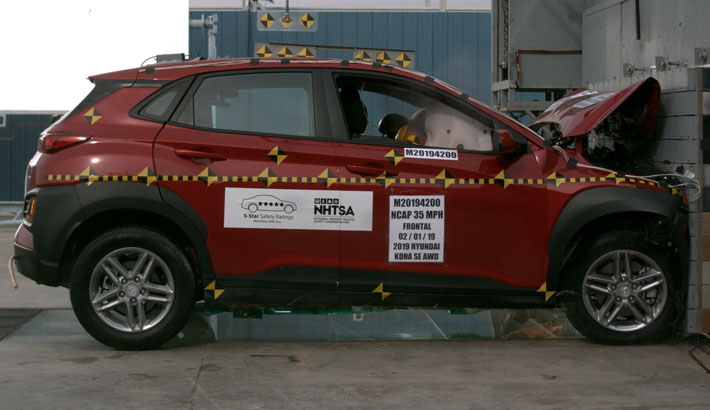
2022 Hyundai Kona SUV AWD
| Frontal crash | ★★★★★ |
|---|---|
| Side crash | ★★★★★ |
| Rollover | ★★★★★ |
| Rollover risk | 13.6% |
Forward collision warning: Standard · Lane departure warning: Standard
2022 Hyundai Kona SUV FWD
| Frontal crash | ★★★★★ |
|---|---|
| Side crash | ★★★★★ |
| Rollover | ★★★★★ |
| Rollover risk | 14.1% |
Forward collision warning: Standard · Lane departure warning: Standard
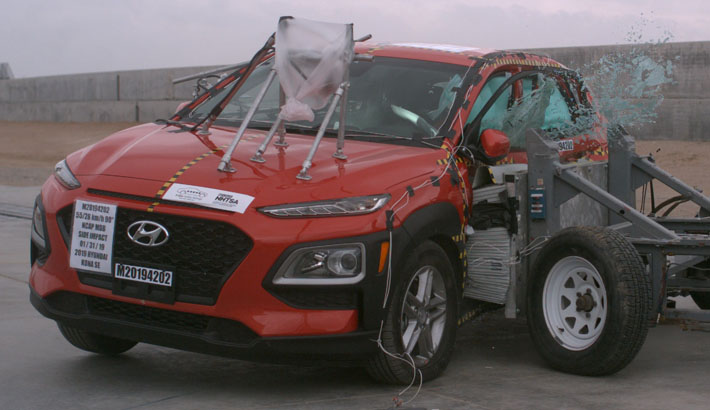
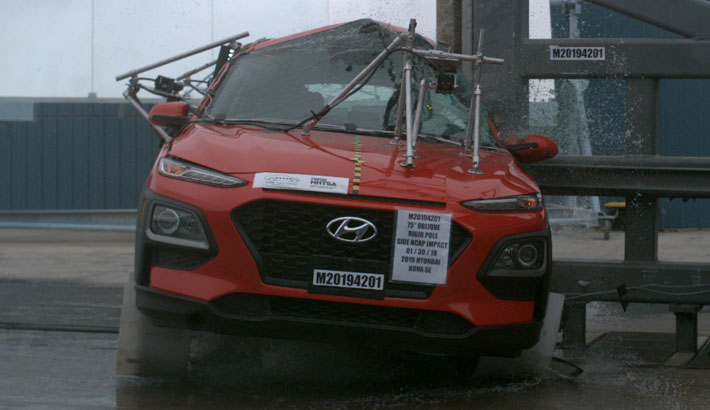
NHTSA 5-Star Safety Ratings (New Car Assessment Program). Ratings are comparable only between vehicles of similar size and weight, and ratings from 2011 on use tougher tests than earlier years. Photos: NHTSA.
Fuel economy
Kona FWD
| City / highway | 29 / 35 mpg |
|---|---|
| Fuel | Regular Gasoline |
1.6 L · 4 cyl · Automatic (AM-S7) · Front-Wheel Drive · about $2,100/year to fuel
Kona FWD
| City / highway | 30 / 35 mpg |
|---|---|
| Fuel | Regular Gasoline |
2 L · 4 cyl · Automatic (AV-S1) · Front-Wheel Drive · about $2,100/year to fuel
Kona AWD
| City / highway | 28 / 33 mpg |
|---|---|
| Fuel | Regular Gasoline |
2 L · 4 cyl · Automatic (AV-S1) · All-Wheel Drive · about $2,250/year to fuel
Kona AWD
| City / highway | 27 / 32 mpg |
|---|---|
| Fuel | Regular Gasoline |
1.6 L · 4 cyl · Automatic (AM-S7) · All-Wheel Drive · about $2,300/year to fuel
EPA estimates from fueleconomy.gov for each engine and transmission sold. Annual cost is the EPA's estimate for 15,000 miles a year at its current fuel and electricity price assumptions. Your results will vary.
What owners report
| Problem area | Complaints | Typical mileage* |
|---|---|---|
| Engine | 33 | 19,842 mi |
| Unknown or other | 26 | — |
| Electrical systemIgnition › Coil; Horn | 22 | — |
| Power train | 18 | 23,421 mi |
| Forward collision avoidanceAutomatic emergency braking; Adaptive cruise control | 18 | — |
| Vehicle speed control | 10 | — |
| Service brakes | 9 | — |
| Lane departureAssist; Blind spot detection | 3 | — |
| Fuel/propulsion system | 2 | — |
| Exterior lightingTail lights | 2 | — |
| Air bags | 2 | — |
| VisibilitySun/moon roof assembly | 2 | — |
*Median odometer reading when the problem happened, where owners gave one. One complaint can name several problem areas.
Recent owner complaints
- Forward collision avoidance › Automatic emergency braking
The vehicle is a 2022 Hyundai Kona N Line, VIN [XXX]. The driver-assistance/safety systems have intermittently malfunctioned. The reported problems include false forward-collision warnings, unintended automatic emergency braking when there is no apparent obstacle or collision threat, false blind-spot/side warnings, and unwanted steering intervention from the lane-assist system. The exact failed component is UNKNOWN. Possible involved systems include the Forward Collision-Avoidance Assist system, Lane Keeping/Lane Following Assist, Blind-Spot Collision Warning/Collision-Avoidance Assist, related cameras/radar sensors, control modules, wiring, or software. The vehicle remains available for…
- Vehicle speed control
I purchased this 2022 Hyundai Kona used in May 2025 with approximately 55,000 miles. Within about one to two months of purchase, in June 2025, the transmission began to malfunction. When I pressed the accelerator, the speedometer and engine speed would climb but the vehicle would not accelerate, resulting in a sudden loss of acceleration while driving. This happened in traffic on a public road, which put me at serious risk of being rear-ended and left me unable to safely merge, cross intersections, or maintain speed. The vehicle was taken to a Hyundai dealership service center, which diagnosed a transmission failure and performed a transmission repair in August 2025. In October 2026, about…
- Forward collision avoidance › Automatic emergency braking
Today, my Kona tried to kill me. I was traveling on a freeway in a construction zone. Road conditions were clear: no fog, precipitation, potholes or obstructions. Traffic slowed down to 30 mph as the rightmost lane becomes an exit only lane (and people exchanged between the middle and right lane). Traffic continued to flow freely around 50 mph in the left lane. I was in the middle lane, and after passing the off ramp my lane was clear for at least an eighth of a mile ahead (all visible traffic in front of me had taken the exit). I began to accelerate back up to freeway speeds when the "Automatic Emergency Braking" engaged for no reason. There was a curved driving path on the display (which…
- Engine
My radiator has coolant leak. I noticed the fluid getting low and the smell. I had to put fluid in 2-3 times the last month. I took it into the shop and they confirmed that it is the lower left part of the radiator that itâs leaking from and it has to get replaced. I did notice on a campaign 24\-EM\-005H\. for the Hyundai Kona 2022. But my VIN number wasnât part of that. It is having the same leak and I have to get the radiator replaced. My car has 65000 miles on it so it wasnât covered under warranty. It is in the auto shop now and will cost me over 1200 to get it fixed.
- Power train
Transmission (7 speed DCT) partial failure causing intermittent lack of acceleration, bucking, violent shifts. No warning lights are displayed. Despite being only days and about 1000 miles beyond the warranty neither Hyundai nor the dealer show interest in repairing this except at my cost, which is not feasible.
- Power train
The contact owns a 2022 Hyundai Kona. The contact stated that while driving 65 MPH and depressing the accelerator pedal, the vehicle failed to respond as intended. No warning lights illuminated. A dealer was contacted. The vehicle was serviced under NHTSA Campaign Number: 22V746000 (POWER TRAIN); by the owner, but the remedy failed to fix the vehicle. The contact stated that the failure had occurred after the recall repair was performed. The contact stated that the failure had occurred twice. The manufacturer was notified of the failure and informed the contact that the issue would be escalated. The failure mileage was 27,000.
- Electrical system
COMPONENT/SYSTEM: Air Conditioning (HVAC) / Climate Control System and closed-loop refrigerant lines. The vehicle and all climate control components are available for immediate inspection. SAFETY RISK: Total loss of cooling in peak summer heat (90°F-95°F+) causes cabin temperatures to rapidly exceed 110°F. This sudden heat trapped in the vehicle caused me (the driver) acute heat exhaustion, culminating in a medical fainting episode. The vehicle regularly transports my newborn baby and toddler, subjecting them to severe heatstroke risks. Additionally, an ongoing 4-year chemical refrigerant leak inside an enclosed EV cabin creates an active toxic inhalation hazard for all passengers.…
- TiresCrash
The tread came off the tire on the highway causing me to crash off I 75. The tires were made 6 of 2025 and the pressure was 31.5 according to the highway patrol officer on scene. I have the paperwork for the tires I purchased at Sams Club in Cape Coral Florida on 7/29/25. The tires are less than 11 months old and this shouldn't have happened. The tread damaged multiple parts of my car.
Owner complaints are submitted to NHTSA by the public and are not verified. Shown as filed (NHTSA removes personal details); long reports are shortened.
NHTSA defect investigations
- Pedestrian alert soundsClosedLed to recall 22V063000
NHTSA received a petition on or about July 18, 2022, requesting that Federal Motor Vehicle Safety Standard (FMVSS) 141 be applied to all electric and hybrid vehicles operating in the United States. The petition can be reviewed at NHTSA.gov under ODI Number 11486072. FMVSS 141 establishes performance requirements for pedestrian alert sounds for motor vehicles. The standard applies to hybrid and electric vehicles that have a gross vehicle weight rating of 4,536 KG or less or are defined as low-speed vehicles. The standard became fully applicable to all such vehicles manufactured on or after March 1, 2021.On January 27, 2023, NHTSA opened Defect Petition (DP) 22-005 to evaluate the subject matter described in the petition. On June 24, 2023 and as supplemented on June 25, 2023, the petitioner notified NHTSA he was withdrawing his petition. The petitioner indicated that, based on his review…
- Loss of Motive PowerClosed
The National Highway Traffic Safety Administration (NHTSA) received a letter dated July 13, 2022, petitioning the Agency to initiate a safety defect investigation into loss of motive power allegations attributed to oil drain pan assembly failures on certain Hyundai Motor America, Inc. and Kia America, Inc. vehicles spanning Model Years (MY) 2005-2021. The Petitioners cited examples of complaints indicating that the subject vehicles were experiencing rapid loss of engine oil due to oil drain plug back outs, resulting in loss of motive power and/or catastrophic engine damage. Additional complaints were provided which alleged that the oil drain pans lack sufficient structural integrity and are susceptible to cracking. The petition itself can be reviewed at NHTSA.gov under ODI number 11481745. On September 12, 2022, the Office of Defects Investigation (ODI) opened Defect Petition (DP22-003)…