The 2023 Tesla Model S has 13 safety recalls and 115 owner complaints on file with NHTSA. The most-reported problem area is unknown or other (58 complaints).
Recalls13safety recalls
Complaints115filed by owners
Crashes · fires8 · 0reported in complaints
Injuries · deaths0 · 0reported in complaints
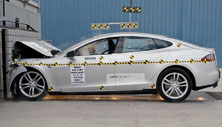
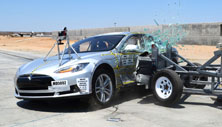
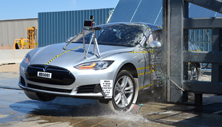
2023 Tesla Model S in an NHTSA crash test
Safety recalls
Back over prevention › Software
NHTSA recall 26V283000 · May 4, 2026 · 218,868 vehicles
Problem: Tesla, Inc. (Tesla) is recalling certain 2017, 2021-2023 Model 3, 2020-2023 Model Y, 2021-2023 Model S, and Model X vehicles operating software version 2026.8.6. The rearview camera image may be delayed when the vehicle is placed in reverse. As such, these vehicles fail to comply with the requirements of Federal Motor Vehicle Safety Standard number 111, "Rear Visibility."
Risk: A delayed rearview image reduces the driver's view behind the vehicle, increasing the risk of a crash.
Fix: Tesla has released an over-the-air (OTA) software update, free of charge. Owner notification letters were mailed July 3, 2026. Owners may contact Tesla customer service at 1-877-798-3752. Tesla's number for this recall is SB-26-00-001.
Air bags
NHTSA recall 25V172000 · Mar 19, 2025 · 91 vehicles
Problem: Tesla, Inc. (Tesla) is recalling certain 2021-2024 Model S and 2021-2025 Model X vehicles. An air bag with the incorrect horn pad may have been installed, preventing the horn from sounding.
Risk: An inoperative horn may prevent the driver from alerting other drivers, increasing the risk of a crash.
Fix: Tesla service will inspect and install an air bag with the correct horn pad as necessary, free of charge. Owner notification letters were mailed May 20, 2025. Owners may contact Tesla customer service at 1-877-798-3752. Tesla's number for this recall is SB-25-20-001.
Components: Air bags; Electrical system › Horn
Air bags › Frontal › Driver side › Cushion
NHTSA recall 24V967000 · Dec 23, 2024 · 487 vehicles
Problem: Tesla, Inc. (Tesla) is recalling certain 2021-2025 Model S and Model X vehicles. The driver's air bag could tear during deployment. As such, these vehicles fail to comply with the requirements of Federal Motor Vehicle Safety Standard (FMVSS) numbers 208, "Occupant Crash Protection" and 212, "Windshield Mounting."
Risk: A torn air bag may not adequately protect an occupant in a crash, increasing the risk of injury.
Fix: Tesla service will replace the air bag assembly, free of charge. Owner notification letters were mailed February 21, 2025. Owners may contact Tesla customer service at 1-877-798-3752. Tesla's number for this recall is SB-24-20-001.
Problem: Tesla, Inc. (Tesla) is recalling certain 2021-2024 Model 3, Model S, Model X, and 2020-2024 Model Y vehicles. The hood latch assembly may fail to detect an unlatched hood condition after the hood has been opened.
Risk: An unlatched hood can fully open, obstructing the driver's view and increasing the risk of a crash.
Fix: Tesla has released an over-the-air (OTA) software update, free of charge. Owner notification letters were mailed September 24, 2024. Owners may contact Tesla customer service at 1-877-798-3752. Tesla's number for this recall is SB-24-00-012.
Components: Electrical system › Software; Latches/locks/linkages › Hood › Latch
Seat belts › Front › Warning light/devices
NHTSA recall 24V376000 · May 28, 2024 · 125,233 vehicles
Problem: Tesla, Inc. (Tesla) is recalling certain 2012-2024 Model S, 2015-2024 Model X, 2017-2023 Model 3, and 2020-2023 Model Y vehicles. In the event of an unbelted driver, the seat belt warning light and audible chime may not activate as intended. As such, these vehicles fail to comply with the requirements of Federal Motor Vehicle Safety Standard number 208, "Occupant Crash Protection."
Risk: A seat belt warning system that fails to alert occupants of an unbelted seat belt can increase the risk of injury during a crash.
Fix: Tesla will release an over-the-air (OTA) software update. Owner notification letters were mailed July 26, 2024. Owners may contact Tesla customer service at 1-877-798-3752. Tesla's number for this recall is SB-24-00-008.
Electrical system › Instrument cluster/panel
NHTSA recall 24V051000 · Jan 30, 2024 · 2,193,869 vehicles · opened after NHTSA action (OVSC)
Problem: Tesla, Inc. (Tesla) is recalling certain 2012-2023 Model S, 2016-2024 Model X, 2017-2023 Model 3, 2019-2024 Model Y, and 2024 Cybertruck vehicles. An incorrect font size is displayed on the instrument panel for the Brake, Park, and Antilock Brake System (ABS) warning lights. As such, these vehicles fail to comply with the requirements of Federal Motor Vehicle Safety Standard number 105, "Hydraulic and Electric Brake Systems" and 135, "Light Vehicle Brake Systems."
Risk: Warning lights with a smaller font size can make critical safety information on the instrument panel difficult to read, increasing the risk of a crash.
Fix: Tesla began releasing an over-the-air (OTA) software update, free of charge. Owners may contact Tesla customer service at 1-877-798-3752. Tesla's number for this recall is SB-24-00-003.
Back over prevention › Sensing system › Camera
NHTSA recall 24V035000 · Jan 22, 2024 · 199,575 vehicles
Problem: Tesla, Inc. (Tesla) is recalling certain 2023 Model S, X, and Y vehicles equipped with full self-driving computer 4.0 and running a software release version 2023.44.30 through 2023.44.30.6 or 2023.44.100. Software instability may prevent the rearview camera image from displaying.
Risk: A rearview image that does not display while in reverse decreases the driver's visibility and increases the risk of a crash.
Fix: Tesla has released an over-the-air (OTA) software update, free of charge. Owner notification letters were mailed March 22, 2024. Owners may contact Tesla customer service at 1-877-798-3752. Tesla's number for this recall is SB-24-00-002.
Electrical system › Software
NHTSA recall 23V862000 · Dec 19, 2023 · 120,423 vehicles
Problem: Tesla, Inc. (Tesla) is recalling certain 2021-2023 Model S and X vehicles. The cabin doors can be unlocked during a crash. As such, these vehicles fail to comply with the requirements of Federal Motor Vehicle Safety Standard number 214, "Side Impact Protection."
Risk: An unlocked door may unlatch and open during a crash, increasing the risk of injury.
Fix: Tesla has released an over-the-air (OTA) software update, free of charge. Owner notification letters were mailed February 17, 2024. Owners may contact Tesla customer service at 1-877-798-3752. Tesla's number for this recall is SB-23-00-009.
Components: Electrical system › Software; Latches/locks/linkages › Doors › Latch
Electrical system › Adas › Driver monitoring › Software
NHTSA recall 23V838000 · Dec 12, 2023 · 2,031,220 vehicles · opened after NHTSA action (ODI)
Problem: Tesla, Inc. (Tesla) is recalling 2012-2023 Model S, 2016-2023 Model X, 2017-2023 Model 3, and 2020-2023 Model Y vehicles equipped with all versions of Autosteer leading up to the version(s) that contains the recall remedy. In certain circumstances when Autosteer is engaged, the prominence and scope of the feature's controls may not be sufficient to prevent driver misuse of the SAE Level 2 advanced driver-assistance feature.
Risk: In certain circumstances when Autosteer is engaged, and the driver does not maintain responsibility for vehicle operation and is unprepared to intervene as necessary or fails to recognize when Autosteer is canceled or not engaged, there may be an increased risk of a crash.
Fix: Tesla will release an over-the-air (OTA) software update, free of charge. Owner notification letters were mailed February 10, 2024. Owners may contact Tesla customer service at 1-877-798-3752. Tesla's number for this recall is SB-23-00-008.
Steering › Steering wheel/handle bar
NHTSA recall 23V743000 · Nov 3, 2023 · 194 vehicles
Problem: Tesla, Inc. (Tesla) is recalling certain 2021-2024 Model S and Model X vehicles. An incorrect air bag may have been installed when the steering yoke or round steering wheel was replaced with a different style of yoke or steering wheel.
Risk: An air bag that is not designed to function with the replacement steering yoke or wheel may deploy incorrectly, increasing the risk of injury during a crash.
Fix: Tesla Service will inspect and replace the driver air bag as necessary, free of charge. Owner notification letters were mailed January 2, 2024. Owners may contact Tesla customer service at 1-877-798-3752. Tesla's number for this recall is SB-23-20-005.
Components: Steering › Steering wheel/handle bar; Air bags › Frontal
Seat belts › Front
NHTSA recall 23V488000 · Jul 14, 2023 · 15,869 vehicles · opened after NHTSA action (ODI)
Problem: Tesla, Inc. (Tesla) is recalling certain 2021-2023 Model S and Model X vehicles. The front-row seat belts may not be connected properly to the pretensioner anchors, which can cause the seat belts to detach.
Risk: A detached seat belt may not properly restrain an occupant during a crash, increasing the risk of injury.
Fix: Tesla Service will inspect the front-row seat belts and connect the seat belts to pretensioner anchors, or replace the seat belt assemblies, as necessary, free of charge. Owner notification letters were mailed September 12, 2023. Owners may contact Tesla customer service at 1-877-798-3752. Tesla's number for this recall is SB-23-20-004.
Forward collision avoidance › Sensing system › Camera
Problem: Tesla, Inc. (Tesla) is recalling certain 2023 Model S, Model X, and Model Y vehicles. The forward-facing camera may be misaligned, causing some of the active safety features such as emergency braking, forward collision warning, and lane assist to become unavailable without alerting the driver.
Risk: Safety features that are unavailable without any warning to the driver may increase the risk of a crash.
Fix: Tesla Service will inspect and adjust the pitch angle, as necessary, free of charge. Owner notification letters were mailed September 12, 2023. Owners may contact Tesla customer service at 1-877-798-3752. Tesla's number for this recall is SB-23-17-006.
Steering › Automated/adaptive steering
NHTSA recall 23V085000 · Feb 15, 2023 · 362,758 vehicles · opened after NHTSA action (ODI)
Problem: Tesla, Inc. (Tesla) is recalling certain 2016-2023 Model S, Model X, 2017-2023 Model 3, and 2020-2023 Model Y vehicles equipped with Full Self-Driving Beta (FSD Beta) software or pending installation. The FSD Beta system may allow the vehicle to act unsafe around intersections, such as traveling straight through an intersection while in a turn-only lane, entering a stop sign-controlled intersection without coming to a complete stop, or proceeding into an intersection during a steady yellow traffic signal without due caution. In addition, the system may respond insufficiently to changes in posted speed limits or not adequately account for the driver's adjustment of the vehicle's speed to exceed posted speed limits.
Risk: FSD Beta software that allows a vehicle to exceed speed limits or travel through intersections in an unlawful or unpredictable manner increases the risk of a crash.
Fix: Tesla will release an over-the-air (OTA) software update, free of charge. Owner notification letters were mailed April 15, 2023. Owners may contact Tesla customer service at 1-877-798-3752. Tesla's number for this recall is SB-23-00-001.
Recall repairs are free at any authorised dealer. A recall listed here may already have been fixed on a particular car: enter its 17-character VIN at nhtsa.gov/recalls to see open recalls.
Crash test ratings
NHTSA side barrier crash testNHTSA side pole crash test
2023 Tesla Model S (All Variants) 5 HB AWD Early Release
Overall
Not Rated
Frontal crash
Not Rated
Side crash
Not Rated
Rollover
★★★★★
Rollover risk
5.7%
Forward collision warning: Standard · Lane departure warning: Standard
2023 Tesla Model S (All Variants) Later Release 5 HB AWD
Overall
Not Rated
Frontal crash
Not Rated
Side crash
Not Rated
Rollover
★★★★★
Rollover risk
5.7%
Forward collision warning: Standard · Lane departure warning: Standard
NHTSA 5-Star Safety Ratings (New Car Assessment Program). Ratings are comparable only between vehicles of similar size and weight, and ratings from 2011 on use tougher tests than earlier years. Photos: NHTSA.
Range & efficiency
Model S EV
405mi range
Efficiency
28.2 kWh/100 mi
MPGe city / hwy / comb
124 / 115 / 120
Charge time (240 V)
15 h
Automatic (A1) · All-Wheel Drive · about $650/year to charge
EPA estimates from fueleconomy.gov for each engine and transmission sold. Annual cost is the EPA's estimate for 15,000 miles a year at its current fuel and electricity price assumptions. Your results will vary.
Electrical system Horn; Adas › Autonomous/self driving
10
2
0
0
—
Vehicle speed control
7
1
0
0
—
Service brakes
6
0
0
0
—
Visibility/wiper
6
0
0
0
—
Wheels
5
0
0
0
—
Exterior lighting
5
0
0
0
—
Lane departure Warning; Assist
4
0
0
0
—
Suspension
4
0
0
0
—
Structure Body
3
0
0
0
—
*Median odometer reading when the problem happened, where owners gave one. One complaint can name several problem areas.
Recent owner complaints
Oct 24, 2026Service brakes While driving at freeway speed at about 9:15 PM with Full Self-Driving (Supervised) engaged, the car suddenly jerked and told me to take over. Several safety systems then failed at once: ABS disabled (ESP_a025), stability control disabled (DI_a222), traction control disabled (DI_a223), Automatic Emergency Braking unavailable (APP_w009), Vehicle Hold disabled (DI_a245, DI_a246), steering assist reduced (UI_a020), and lane departure avoidance unavailable (APP_w264). Steering became very heavy and regenerative braking stopped, so the car coasted freely and would only slow with the brake pedal. I exited the freeway and drove slowly home. The alerts stayed active after a reboot. The car was…
Sep 29, 2026Vehicle speed control Tesla removed speed control from their "full self-driving" product. They have removed the ability to conveniently switch to normal cruise control (have to pull over on freeway or get off freeway to park first) and speed profiles use outdated map data and frequently suddenly change speeds. Sometimes they go away faster than the speed limit and sometimes the car suddenly drops 20mp less in the middle of freeway traffic.
Sep 5, 2026Service brakes Catastrophic structural failure of the rear driver-side (LH) brake caliper assembly on a 2023 Tesla Model S Plaid at approximately 18,036 miles. While driving normally on a public roadway, the factory-installed rear LH brake caliper bolts backed out completely due to improper assembly torque or a latent material defect. The unbolted caliper detached entirely from its mounting bracket and collapsed into the spinning wheel barrel. The caliper became violently wedged between the wheel rim and the rotor, instantly puncturing the wheel, flattening the driver-side rear tire, damaging the passenger-side (RH) rear tire, and causing an immediate loss of vehicle control. The loose caliper acted as an…
Aug 23, 2026Steering My 2023 Tesla Model S has a horn activated by a small button on the right side of the steering wheel rather than by pressing the center of the steering wheel. During a recent dangerous traffic situation, I needed to use the horn immediately to warn another driver, but I could not locate and activate the horn button quickly enough while concentrating on avoiding the hazard. No collision occurred. The incident occurred approximately on August 23â24, 2026; I do not recall the exact date. I reported this to Tesla as a safety concern. Tesla confirmed that my vehicle can be converted to the newer steering wheel configuration with a mechanical center horn. Tesla initially quoted $1,177.34 for…
Aug 8, 2026Unknown or other My Tesla Model S has a touch-sensitive horn button on the right side of the steering wheel. In urgent situations, I've often had difficulty quickly locating it to get another driver's attention. Tesla quoted me $1800 to replace the steering wheel with a model that has the horn in the center, like most other cars. This is a safety concern because owners shouldn't have to pay to move the horn for safety reasons. Tesla should be required to retrofit any model with a touch button for the horn to one with the horn in the center of the steering wheel.
Aug 4, 2026 · 150,332 miles · crashElectrical system The contact owns a 2023 Tesla Model 3. The contact stated that while exiting a supercharging station with the Full Self-Driving (FSD) feature engaged, the message "Take Over Immediately" was displayed. The contact stated that the vehicle abruptly accelerated into an intersection and crashed head-on with another vehicle. The air bags deployed as needed. The contact stated that a Police report was filed; however, the report number was not provided. There were no injuries sustained. The vehicle was towed to an independent mechanic, where it remained undiagnosed and unrepaired. The manufacturer was notified of the failure but provided no assistance. The failure mileage was 150,332.
Apr 9, 2026Seats âThe driver's seat assembly on the vehicle suffers from a critical mechanical and software tracking defect that causes the seat to permanently jam into a mechanical lock, creating an immediate and severe safety hazard. âThe electronic calibration soft-stops for the driver's seat allow the mechanism to travel past the safe limits of the track when indexed or operated. When the seat reaches the absolute mechanical limit of the rear rail, the lead screw/worm gear mechanism binds tightly, resulting in a total mechanical lock where the motor lacks the breakaway torque to reverse direction. This causes the driver's seat to become permanently stuck in the fully rearward position. âThis…
Jun 12, 2026Seat belts Repeated warning of failure of Front left safety restraint system. Now also a seatbelt warning light. Have already bright car to service three times. Tesla acknowledges inability to resolve recurrent issue. I think this was a recall issue for previous years of this model, Model S. Most recent yesterday, Friday, June 12, 2026.
Owner complaints are submitted to NHTSA by the public and are not verified. Shown as filed (NHTSA removes personal details); long reports are shortened.
NHTSA defect investigations
EA26002 · opened Mar 18, 2026 · openFSD Collisions in Reduced Roadway Visibility Conditions The Office of Defects Investigation (ODI) is opening this Engineering Analysis to evaluate Teslaâs Full Self Driving Beta and Full Self Driving (Supervised) (collectively, FSD) degradation detection system. The focus of this investigation will be to assess the systemâs ability, when encountering reduced roadway visibility conditions, to detect degradation and alert the driver with sufficient time to respond. ODI will evaluate the performance of FSD in degraded roadway conditions and the updates or modifications by Tesla to the degradation detection system, including the timing, purpose, and capabilities of the updates, and Teslaâs assessment of their safety impact. Teslaâs FSD is an advanced driver assistance system (ADAS) that relies exclusively on vision-based cameras and the related FSD software to detect and respond to the roadway ahead, projecting a path forward based on…
PE25012 · opened Oct 7, 2025 · openTraffic safety violations while Full Self Driving ("FSD") is engaged The Office of Defects Investigation (âODIâ) is opening this Preliminary Evaluation (PE) to assess the scope, frequency, and potential safety consequences of FSD executing driving maneuvers that constitute traï¬c safety violations. This investigation concerns versions of FSD that Tesla has labeled as "FSD (Supervised)" and "FSD (Beta)." Tesla characterizes FSD as an SAE Level 2 partial automation system requiring a fully attentive driver who is engaged in the driving task at all times. Level 2 partial automation systems are designed to support and assist the driver in performing certain aspects of the driving task, requiring a driver to supervise and intervene as necessary. The driver remains fully responsible at all times for driving the vehicle, including complying with applicable traï¬c laws. ODIâs investigation will therefore focus, in particular, on whether certain driving…
AQ25002 · opened Aug 20, 2025 · openCompliance with Standing General Order 2021-01 Reporting Requirements The Office of Defects Investigation (âODIâ) has identified numerous incident reports submitted by Tesla, Inc. (âTeslaâ) in response to Standing General Order 2021-01 (the âSGOâ), in which the reported crashes occurred several months or more before the dates of the reports. The majority of these reports involved crashes in which the Standing General Order in place at the time required a report to be submitted within one or five days of Tesla receiving notice of the crash. When the reports were submitted, Tesla submitted them in one of two ways. Many of the reports were submitted as part of a single batch, while others were submitted on a rolling basis. Preliminary engagement between ODI and Tesla on the issue indicates that the timing of the reports was due to an issue with Teslaâs data collection, which, according to Tesla, has now been fixed. NHTSA is opening this Audit…
PE24033 · opened Jan 6, 2025 · closed Apr 3, 2026Actually Smart Summon sessions resulting in low-speed impacts. On January 6, 2025, the Office of Defects Investigations (ODI) opened Preliminary Evaluation 24003 (PE24033) to investigate Actually Smart Summon (Summon) sessions resulting in crashes during active sessions. According to Tesla, Summon is a short-distance SAE Level 2 system, controlled by the user from a cell phone within a certain distance and intended for use in parking lots and on private property. ODI analyzed complaint data provided by Tesla as well as complaints submitted to ODI from consumers to identify Summon incidents resulting in crashes. ODI's analysis indicates that almost all Summon reported crashes involved minor property damage claims with no reported incidents involving a vulnerable road user, injury, fatality, or major property damage as indicated by an air bag deployment or vehicle tow away. Out of millions of Summon sessions, a fraction of 1% resulted in an incident.…
PE24031 · opened Oct 17, 2024 · closed Mar 18, 2026FSD Collisions in Reduced Roadway Visibility Conditions On October 17, 2024, NHTSAâs Office of Defects Investigation (ODI) opened a Preliminary Evaluation (PE24031) of Teslaâs Full Self Driving Beta and Full Self Driving (Supervised) (collectively, FSD) to assess: the ability of the FSD system to detect and respond appropriately to reduced roadway visibility conditions; whether any other FSD crashes had occurred under degraded roadway visibility conditions that are similar in nature to the four SGO-reported crashes identified in the opening document, and if so, the contributing circumstances for each of those crashes; and any updates or modifications by Tesla to the FSD system that may affect the performance of FSD in degraded roadway visibility conditions, including the timing, purpose, and capabilities of any such updates, and Teslaâs assessment of their safety impact. Teslaâs FSD is an advanced driver assistance system (ADAS) that…
RQ24009 · opened Apr 25, 2024 · openRecall 23V838 Remedy Effectiveness The Office of Defects Investigation (ODI) is opening a Recall Query to assess the remedy adequacy of Recall 23V838. On December 12, 2023, Tesla filed a Defect Information Report (Recall 23V838) applicable to all Tesla models produced and equipped with any version of its Autopilot system, which Tesla described as an SAE Level 2 (L2) Advanced Driver Assistance System (ADAS). Autopilot is the simultaneous engagement of Teslaâs Traffic-Aware Cruise Control (TACC) and Autosteer. In describing the safety defect, Teslaâs Defect Information Report (DIR) explained that âthe prominence and scope of the systemâs controls may be insufficient to prevent driver misuse,â and Tesla committed to the deployment of a multipart remedy aimed at improving system and engagement controls and reducing mode confusion. EA22002 (upgraded from PE21020) was opened to investigate whether Teslaâs Autopilot…
DP23002 · opened Jun 29, 2023 · openSudden Unintended Acceleration The Office of Defects Investigation (ODI) received a petition requesting that ODI reevaluate its decision to deny DP20-001 on the basis that intermittent high electrical current demands on the vehicles' 12VDC systems may have caused some or all of the incidents examined by ODI in DP20-001. The petitioner bases this information on a review of open-source research and the DP20-001 denial. The petition and related materials can be reviewed at NHTSA.gov under the following ODI number: 11528471.
DP23001 · opened Apr 7, 2023 · closed Mar 18, 2026Defect Petition Interlock Request On March 21, 2023, the Office of Defects Investigation (ODI) received a petition requesting a ârecall of all Tesla carsâ produced from 2013 to the date on which the petition was filed due to what Petitioner considers to be the increased likelihood of pedal misapplication. Attached to the Petition is a paper authored by Petitioner. According to Petitioner, the differences in the operator controls between the subject Tesla vehicles and internal combustion engine powered vehicles promote driver pedal misapplication, leading to sudden unintended acceleration (SUA) incidents. To fix this alleged defect, Petitioner argues that the subject vehicles should be equipped with measures that require: (i) occasional removal of the driverâs foot from the pedals; and (ii) application of the brake pedal before fully stopping the vehicle. ODI evaluated the allegations by, among other things,…
PE23006 · opened Mar 24, 2023 · closed May 16, 2024 · led to recall 23V488Front seat belt anchor detachment On March 24, 2023, the Office of Defects Investigation (ODI) opened this Preliminary Evaluation (PE) after receiving 2 consumer complaints alleging the front seat belts had suddenly detached from the outboard lap pretensioner anchor while in motion in model year (MY) 2022-2023 Tesla Model X vehicles. In its June 19, 2023 response to ODIâs May 4, 2023 Information Request letter of the PE, Tesla reported that its review of field repair data identified 12 additional warranty claims of the subject condition in the affected vehicles. On July 14, 2023, Tesla filed a safety recall (NHTSA No. 23V-488) of 15,869 MY 2021 - 2023 Tesla Model S and Model X vehicles. The recall remedy is an inspection of the 1st row seat belts for proper connection to the pretensioners. Service personnel will resecure the pretensioners or, if necessary, replace the seat belt retractor assembly. In its recall…
EA22002 · opened Jun 8, 2022 · closed Apr 25, 2024 · led to recall 23V085Autopilot System Driver Controls The Office of Defects Investigation (ODI) upgraded PE21020 to EA22002 on June 8, 2022, to extend work and deepen the PE21020 crash analysis, to supplement that analysis with additional data, and to perform vehicle evaluations to understand how Teslaâs Autopilot system may exacerbate human factors or behavioral safety risks by undermining the effectiveness of the driverâs supervision. To support this work, ODI collected additional crash information and assessed vehicle control authority, driver engagement technologies, and related human factors considerations associated with partial automation via analysis of peer vehicle data and hands-on vehicle evaluation, assessments from NHTSA human factors subject matter experts, and reviews of related publications dedicated to partial driving automation. Autopilot is the simultaneous use of the features that Tesla calls Traffic-Aware Cruise…