The 2017 Volvo XC90 has 7 safety recalls and 81 owner complaints on file with NHTSA. The most-reported problem area is engine (25 complaints).
Recalls7safety recalls
Complaints81filed by owners
Crashes · fires3 · 9reported in complaints
Injuries · deaths12 · 0reported in complaints
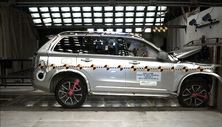
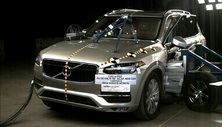
2017 Volvo XC90 in an NHTSA crash test
Safety recalls
Seat belts › Critical fasteners
NHTSA recall 23V827000 · Dec 7, 2023 · 2,911 vehicles
Problem: Volvo Car USA, LLC (Volvo Car) is recalling certain 2015-2024 XC90 vehicles. The second-row seat belt buckle and lower belt anchor bolts may not be tightened properly.
Risk: An improperly tightened seat belt buckle may not restrain an occupant as intended, increasing their risk of injury during a crash.
Fix: Dealers will inspect and tighten the second-row seat belt buckle anchorage bolts, as necessary, free of charge. Owner notification letters were mailed January 19, 2024. Owners may contact Volvo Car customer service at 1-800-458-1552. Volvo Car's number for this recall is R10259.
Problem: Volvo Car USA, LLC (Volvo Car) is recalling certain 2016-2020 XC90 Excellence vehicles. Liquid or condensation on the rear seat control display may cause the front passenger seat to move back as far as possible.
Risk: The rear passenger may become trapped by the front seat without the ability to cancel the seat's movement, increasing the risk of injury.
Fix: Volvo Car will notify owners, and dealers will update the rear seat control display software, free of charge. Owner notification letters were mailed July 14, 2021. Owners may contact Volvo Car customer service at 1-888-458-1552. Volvo Car's number for this recall is R10093.
Electrical system › Software
NHTSA recall 18V800000 · Nov 13, 2018 · 17,548 vehicles
Problem: Volvo Car USA LLC (Volvo) is recalling certain 2017-2019 Volvo XC90, S90, V60, V60 Cross Country, V90, XC40, XC60, and V90 Cross Country vehicles. The software installed in the Vehicle Connectivity Module (VCM) may have an error causing the Telematics and Driver Support Systems to function improperly. As a result, the GPS will not provide location information to emergency personnel in the event of an emergency.
Risk: If the GPS location is not provided to emergency personnel it can inhibit emergency response in the event of a crash or injury.
Fix: Volvo will notify owners, and dealers will correct the software, free of charge. The recall began December 26, 2018. Owners may contact Volvo customer service at 1-800-458-1552. Volvo's number for this recall is R39917.
Seat belts
NHTSA recall 17V370000 · Jun 8, 2017 · 1,305 vehicles
Problem: Volvo Car USA LLC (Volvo) is recalling certain 2017 XC90 vehicles. The Micro Gas Generator (MGG), a subcomponent part used within the right hand side seat belt retractor for the third row seats, may detach after the seatbelt retractor pretensioner is deployed.
Risk: Although, the seat belt will operate as intended in the event of a crash, if the MGG detaches, it may be a projectile within the vehicle cabin, increasing the risk of injury.
Fix: Volvo will notify owners, and dealers will replace the third row passenger's side seatbelt retractor, free of charge. The recall began August 4, 2017. Owners may contact Volvo customer service at 1-800-458-1552. Volvo's number for this recall is R89716.
Air bags › Side/window
NHTSA recall 17V104000 · Feb 16, 2017 · 10,476 vehicles
Problem: Volvo Car USA LLC (Volvo) is recalling certain 2017 XC90, S90, and V90 Cross Country vehicles. The bolts that secure the Inflatable Curtain (IC) air bags in place may break, possibly resulting in the IC air bag deploying improperly in the event of a crash. As, such, these vehicles fail to comply with the requirements of Federal Motor Vehicle Safety Standard (FMVSS) number 226, "Ejection Mitigation."
Risk: If the IC air bags do not deploy properly in the event of a crash, the vehicle occupants have an increased risk of injury.
Fix: Volvo will notify owners, and dealers will inspect and replace the bolts, as necessary, free of charge. The recall is expected to begin April 1, 2017. Owners may contact Volvo customer service at 1-800-458-1552. Volvo's number for this recall is R89714.
Seat belts › Front › Buckle assembly
NHTSA recall 16V798000 · Nov 2, 2016 · 74,027 vehicles
Problem: Volvo Car USA LLC (Volvo) is recalling certain model year 2016-2017 XC90, S90, XC60, V60 Cross Country, V60, S60 Cross Country, S60, and S60 Inscription vehicles manufactured February 16, 2015, to August 22, 2016. On the affected vehicles, the front passenger seat belt buckle attaching stud may loosen, allowing the buckle to separate from the seat belt bracket. As such, these vehicles fail to comply with the requirements of Federal Motor Vehicle Safety Standard (FMVSS) number 210, "Seat Belt Assembly Anchorages" and number 209, "Seat Belt Assemblies."
Risk: If the seat belt buckle separates from the bracket, the front seat passenger may not be adequately restrained in the event of a crash, increasing their risk of injury in the event of a crash.
Fix: Volvo will notify owners, and dealers will inspect the front passenger seat belt buckle stud, replacing the seat belt buckle as needed, free of charge. The recall began January 2017. Owners may contact Volvo customer service at 1-800-458-1552. Volvo's number for this recall is R89708.
Problem: Volvo Cars of North America, LLC (Volvo) is recalling certain model year 2016-2017 Volvo XC90 and S90 vehicles manufactured April 15, 2015 through September 19, 2016. In the affected vehicles, the drain hose for the air conditioning may leak into the passenger compartment due to a drain hose installation error during manufacturing.
Risk: Significant water drainage into the passenger compartment may adversely affect air bag deployment in the event of a crash, increasing the risk of occupant injury.
Fix: Volvo will notify owners, and dealers will inspect the air conditioning drain hose for proper installation, replacing the hose as necessary, free of charge. The recall is expected to begin on November the 14, 2016. Owners may contact Volvo at 1-800-458-1552. Volvo's number for this campaign is R89707.
Components: Equipment › Appliance › Air conditioner; Air bags
Recall repairs are free at any authorised dealer. A recall listed here may already have been fixed on a particular car: enter its 17-character VIN at nhtsa.gov/recalls to see open recalls.
Crash test ratings
NHTSA side barrier crash testNHTSA side pole crash test
2017 Volvo XC90 T5 SUV FWD
Overall
Not Rated
Frontal crash
★★★★★
Side crash
★★★★★
Rollover
Not Rated
Forward collision warning: Standard · Lane departure warning: Standard
2017 Volvo XC90 T5 SUV AWD
Overall
★★★★★
Frontal crash
★★★★★
Side crash
★★★★★
Rollover
★★★★★
Rollover risk
17.9%
Forward collision warning: Standard · Lane departure warning: Standard
2017 Volvo XC90 T6 SUV FWD
Overall
Not Rated
Frontal crash
★★★★★
Side crash
★★★★★
Rollover
Not Rated
Forward collision warning: Standard · Lane departure warning: Standard
2017 Volvo XC90 T6 SUV AWD
Overall
★★★★★
Frontal crash
★★★★★
Side crash
★★★★★
Rollover
★★★★★
Rollover risk
17.9%
Forward collision warning: Standard · Lane departure warning: Standard
2017 Volvo XC90 T8 SUV AWD
Overall
★★★★★
Frontal crash
★★★★★
Side crash
★★★★★
Rollover
★★★★★
Rollover risk
15.9%
NHTSA 5-Star Safety Ratings (New Car Assessment Program). Ratings are comparable only between vehicles of similar size and weight, and ratings from 2011 on use tougher tests than earlier years. Photos: NHTSA.
Fuel economy
XC90 AWD PHEV Plug-in Hybrid
25mpg combined
City / highway
24 / 27 mpg
Electric range
14 mi
On electricity
54 MPGe · 60 kWh/100 mi
Fuel
Premium Gasoline
2 L · 4 cyl · Automatic (S8) · All-Wheel Drive · about $3,300/year to fuel
XC90 FWD
24mpg combined
City / highway
22 / 26 mpg
Fuel
Premium Gasoline
2 L · 4 cyl · Automatic (S8) · Front-Wheel Drive · about $3,400/year to fuel
XC90 AWD
23mpg combined
City / highway
22 / 25 mpg
Fuel
Premium Gasoline
2 L · 4 cyl · Automatic (S8) · All-Wheel Drive · about $3,550/year to fuel
XC90 AWD
22mpg combined
City / highway
20 / 25 mpg
Fuel
Premium Gasoline
2 L · 4 cyl · Automatic (S8) · All-Wheel Drive · about $3,750/year to fuel
EPA estimates from fueleconomy.gov for each engine and transmission sold. Annual cost is the EPA's estimate for 15,000 miles a year at its current fuel and electricity price assumptions. Your results will vary.
*Median odometer reading when the problem happened, where owners gave one. One complaint can name several problem areas.
Recent owner complaints
Sep 18, 2026 · fire · 1 injuryEngine On 9/18/2026 at about 3:15 PM, the low coolant warning came on while I was driving in front of my child's school. Less than a minute later I pulled into the school pickup line, stopped, and turned the vehicle off. There was no smoke when I turned it off. After the engine was off, smoke began coming from the engine compartment, and within minutes the engine compartment was on fire. The fire occurred in a school pickup line surrounded by parents and children. An independent witness saw that the vehicle was off before any smoke appeared. The fire department and police responded. The engine compartment was destroyed and the vehicle is a total loss. Warning before failure: low coolant message,…
Sep 30, 2026Steering Volvo electric power steering system failure.
Apr 2, 2026Fuel/propulsion system Vehicle has exhibited lagging and stalling while driving in "Pure" (electric-only) mode since approximately April 2026, at approximately 85,000 miles, accompanied by an illuminated check engine light. This has occurred repeatedly at red lights, intersections, stop signs, and in stop-and-go traffic, creating a risk of sudden loss of propulsion in live traffic situations, including at intersections where an unexpected stall could result in a collision. The dealership (Volvo Cars of Fort Washington) has diagnosed this as originating from multiple hybrid drivetrain components over several repair visits: the High Voltage Coolant Heater (replaced per a referenced Volvo Technical Service…
Jul 6, 2026 · 2 injuriesElectrical system 2017 Volvo XC90 manufacturing defect where panoramic sunroof drainage network fails under normal rain, pooling water directly in the floorboard channels over safety module networks and wire harnesses.Water infiltration caused a catastrophic short-circuit of the floorboard-mounted amplifier while driving. This forced the audio system to emit an un-modulated, maximum-volume electronic blast through the cabin, causing severe driver distraction and documented temporary acute acoustic trauma/ear injuries to myself and my young child.Progressive electronic oxidation from ongoing water intrusion has since caused systemic failures of critical safety electronics. This includes spontaneous,…
Aug 29, 2026 · fireUnknown or other I was driving my 2017 Volvo XC90 T6 Inscription when a âcoolant lowâ warning appeared. I immediately pulled over and the car began to smoke. I was unaware what to do so I called my husband and he told me to pop my hood. With 1.5 minutes of pulling over I open my door to find the lack to pop the hood and someone started yelling at me to get out. I looked up and the smoke had changed from white to brown- I exited the vehicle and called 911- Within approximately 5 minutes, the vehicle became fully engulfed in flames and was a total loss. The vehicle had been regularly maintained and to my knowledge, had no open recalls applicable at the time. After the fire, I became aware of a prior XC90…
Aug 22, 2026Power train 2017 Volvo XC90 T8 plug-in hybrid, approximately 81,000 miles, experienced intermittent hesitation/loss of propulsion when accelerating. When acceleration is requested, the vehicle can hesitate before power is delivered, creating a serious safety concern when entering, merging into, or crossing traffic because expected acceleration is not immediately available. Diagnostic testing identified faults in the IEM/ERAD system, including P286D00, Clutch A Engagement Time Performance/Too Slow, and P0A1B62, Drive Motor A Control Module, Algorithm Based Failure. The vehicle is currently being evaluated by an authorized Volvo dealer. I was advised that the high-voltage battery cells appear to be…
Aug 3, 2026 · 94,000 milesElectrical system The contact owns a 2017 Volvo XC90. The contact stated that while driving at an undisclosed speed, the window power switch was enabled; however, the window switch failed to function as intended. The contact stated that the rear-view camera, the door switch, and the air conditioner failed to function as intended. In addition, the contact became aware of water on the front passengerâs side floorboard. The vehicle was taken to the dealer. The vehicle was not diagnosed or repaired by an independent mechanic or dealer. The contact referenced an unknown recall; however, the VIN was not associated with a recall related to the failure. The manufacturer was not made aware of the failure. The…
Jul 4, 2026Engine Spark plugs, fuel injectors, cylinders and cylinder walls, pistons, oxygen sensor. Our safety was put at risk because the vehicles "reduced performance" was triggered and it affected the acceleration of the vehicle. The Volvo dealership was able to reproduce the issue because of the engine misfires.The only alert we received was the day prior our engine needed a liter of oil. We topped off the oil and that alert went away. The day we had the reduced performance we were alerted of that at the time on the highway. It's a little turtle icon. We were not able to accelerate efficiently and it was definitely unsafe to be driving but we had to get home.
Owner complaints are submitted to NHTSA by the public and are not verified. Shown as filed (NHTSA removes personal details); long reports are shortened.
NHTSA defect investigations
DP22005 · opened Jan 27, 2023 · closed Aug 7, 2023 · led to recall 22V063000Pedestrian alert sounds NHTSA received a petition on or about July 18, 2022, requesting that Federal Motor Vehicle Safety Standard (FMVSS) 141 be applied to all electric and hybrid vehicles operating in the United States. The petition can be reviewed at NHTSA.gov under ODI Number 11486072. FMVSS 141 establishes performance requirements for pedestrian alert sounds for motor vehicles. The standard applies to hybrid and electric vehicles that have a gross vehicle weight rating of 4,536 KG or less or are defined as low-speed vehicles. The standard became fully applicable to all such vehicles manufactured on or after March 1, 2021.On January 27, 2023, NHTSA opened Defect Petition (DP) 22-005 to evaluate the subject matter described in the petition. On June 24, 2023 and as supplemented on June 25, 2023, the petitioner notified NHTSA he was withdrawing his petition. The petitioner indicated that, based on his review…