The 2020 Chevrolet Bolt EV has 8 safety recalls and 176 owner complaints on file with NHTSA. The most-reported problem area is electrical system (96 complaints).
Recalls8safety recalls
Complaints176filed by owners
Crashes · fires7 · 4reported in complaints
NHTSA overall5 ★crash-test stars
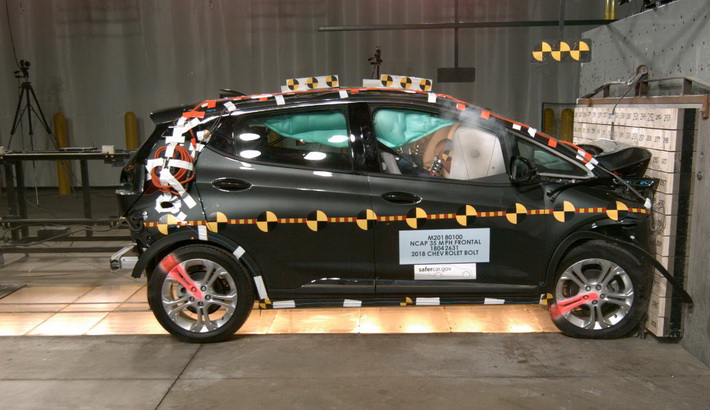
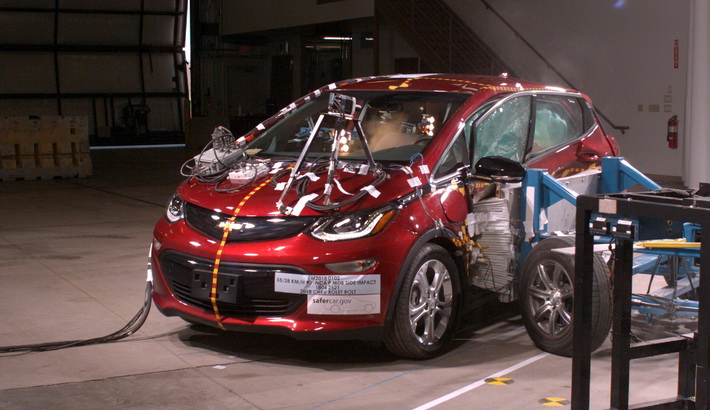
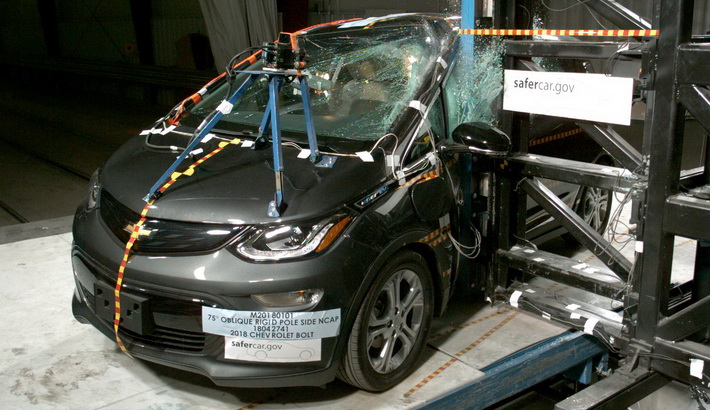
NHTSA crash test
3 recalls for this model year carry an NHTSA park outside advisory. Check your VIN at nhtsa.gov/recalls.
NHTSA advisory: park outside and away from buildings until repaired (fire risk).
Problem
General Motors, LLC (GM) is recalling certain 2020-2022 Chevrolet Bolt EV and 2022 Bolt EUV vehicles previously repaired under Recall 21V-650. The installation of advanced diagnostic software may have failed. As such, the high voltage battery could catch fire when charged to full or nearly full capacity.
Risk
A battery fire increases the risk of injury.
Fix
Owners are advised to take the following interim steps: Set the Target Charge Level feature in their vehicle to limit the charge level to 90%, charge their vehicle more frequently, avoid depleting the battery to 70 miles range remaining, park outside after charging, and do not charge the vehicle indoors overnight. Dealers will reinstall advanced diagnostic software, free of charge. Owner notification letters were mailed December 3, 2024. Owners may contact the Bolt EV Concierge Team at 1-833-382-4389. GM's number for this recall is N242470160.
Components: Electrical system › Propulsion system › Traction battery; Electrical system › Propulsion system › Traction battery thermal › Management › Software
NHTSA advisory: park outside and away from buildings until repaired (fire risk).
Problem
General Motors, LLC (GM) is recalling certain 2020-2022 Chevrolet Bolt EV and 2022 Chevrolet Bolt EUV vehicles that were previously remedied under recall number 21V-650. The advanced diagnostic software may have been incorrectly installed and fail to detect defective battery modules, possibly resulting in a battery fire.
Risk
A battery fire increases the risk of injury.
Fix
Owners are advised to take the following interim steps: Set the Target Charge Level feature in their vehicle to limit the charge level to 90%, charge their vehicle more frequently, avoid depleting the battery to 70 miles range remaining, park outside after charging, and do not charge the vehicle indoors overnight. Dealers will reinstall the advanced diagnostic software, free of charge. Owner notification letters were mailed on August 1, 2024. Owners may contact the Bolt EV Concierge Team at 1-833-382-4389. GM's numbers for this recall are N242443000 and N242443002.
General Motors, LLC (GM) is recalling certain 2017-2023 Chevrolet Bolt EV vehicles. This recall includes certain vehicles previously repaired incorrectly under NHTSA recall number 22V-930. After a crash with seat belt pretensioner deployment, the pretensioner exhaust may ignite carpet fibers near the B-pillar, causing a fire.
Risk
A fire increases the risk of injury.
Fix
Dealers will inspect both front seat belt pretensioners and, if necessary, install metal foil at the carpet near the pretensioner exhaust. Certain vehicles will also need a pretensioner cover installed. Repairs will be performed free of charge. Owner notification letters were mailed January 24, 2024. These vehicles were previously recalled for this same issue under recall number 22V-930 and will need to have the new remedy performed. Owners may contact GM EV Concierge at 1-833-EVCHEVY (1-833-382-4389) (TTY 711 / 1-800-833-2438) or Customer Service at 1-800-222-1020. GM's number for this recall is N232421970.
Components: Seat belts › Pretensioner; Structure › Body › Roof and pillars
General Motors, LLC (GM) is recalling certain 2017-2023 Chevrolet Bolt EV vehicles. After a crash with seat belt pretensioner deployment, the pretensioner exhaust may ignite carpet fibers near the B-pillar, causing a fire.
Risk
A vehicle fire can increase the risk of injury.
Fix
Dealers will install metal foil at the carpet near the pretensioner exhaust, and install a pretensioner cover as necessary, free of charge. Owner notification letters were mailed between January 23, 2023 and April 25, 2023. Owners may contact Chevrolet customer service at 1-800-222-1020. GM's number for this recall is N222383790.
Components: Seat belts › Pretensioner; Structure › Body › Roof and pillars
Electrical systemAug 20, 2021
Propulsion system › Traction battery
Recall 21V65000052,414 vehiclesopened after NHTSA action (ODI)
NHTSA advisory: park outside and away from buildings until repaired (fire risk).
Problem
General Motors, LLC (GM) is recalling certain 2020-2022 Chevrolet Bolt EV and 2022 Chevrolet Bolt EUV vehicles. The high voltage battery could catch fire when charged to full or nearly full capacity.
Risk
A battery fire increases the risk of injury.
Fix
Owners are advised to take the following interim steps: Set the Target Charge Level feature in their vehicle to limit the charge level to 90%, charge their vehicle more frequently, avoid depleting the battery to 70 miles range remaining, park outside after charging, and do not charge the vehicle indoors overnight. Defective battery modules will be replaced by GM, free of charge. Owner notification letters were mailed on October 1, 2021 and June 23, 2023. Owners may contact the Bolt EV Concierge Team at 1-833-382-4389. This recall is an expansion of NHTSA recall 21V-560. GM's number for this recall is N212345940.
General Motors, LLC (GM) is recalling certain 2020 Chevrolet Bolt EV and 2021 GMC Canyon and Sierra 1500, 2500 and 3500, Yukon, Yukon XL, Cadillac Escalade and Escalade ESV and Chevrolet Blazer, Camaro, Colorado, Equinox, Silverado 1500, 2500 and 3500, Suburban and Tahoe vehicles. Incorrect bolts may have been used at one or more fastening locations to secure the seat belts to the vehicle. If an incorrect bolt was used, the seat belt may not be properly attached to the vehicle.
Risk
If a seat belt assembly is not properly attached to the vehicle, the seat belt may not properly restrain an occupant in the event of a crash, increasing the risk of injury.
Fix
GM will notify owners, and dealers will replace the suspect bolts, free of charge. The recall began January 29, 2021. Owners may contact GMC customer service at 1-800-462-8785, Cadillac customer service at 1-800-458-8006, or Chevrolet customer service at 1-800-222-1020. GM's number for this recall is N202322230.
General Motors, LLC (GM) is recalling certain 2020 Chevrolet Bolt EV vehicles. These vehicles may have an improperly cast front left brake caliper that can fracture during a high-pressure braking event.
Risk
If a brake caliper fractures and brake fluid is lost, the vehicle may experience reduced brake performance, increasing the risk of a crash.
Fix
GM will notify owners, and dealers will inspect the casting lot number on the front left brake caliper and replace it if necessary, free of charge. The recall began January 29, 2021. Owners may contact Chevrolet customer service at 1-800-222-1020. GM's number for this recall is N202321400.
General Motors LLC (GM) is recalling certain 2019-2020 Chevrolet Bolt EV vehicles. The door-handle cable inside the rear doors may be too long, allowing contact with the window when it is opened, possibly damaging the cable. A damaged cable may cause the rear door to open unintentionally when the rear window is opened. Additionally, it may cause the rear inside door handle to not work.
Risk
If the rear door opens while driving, or the door handle fails to open the rear door, there is an increased risk of injury to the rear passengers.
Fix
GM will notify owners, and dealers will replace the rear inside door-handle cables, free of charge. The recall began April 17, 2020. Owners may contact Chevrolet customer service at 1-800-222-1020. GM's number for this recall is A202298320.
Recall repairs are free at any authorised dealer. A recall listed here may already have been fixed on a particular car: enter its 17-character VIN at nhtsa.gov/recalls to see open recalls.
Crash test ratings
2020 Chevrolet Bolt EV 5 HB FWD
Overall★★★★★
Frontal crash
★★★★★
Side crash
★★★★★
Rollover
★★★★★
Rollover risk
9.7%
Forward collision warning: Optional · Lane departure warning: Optional
NHTSA side barrier crash testNHTSA side pole crash test
NHTSA 5-Star Safety Ratings (New Car Assessment Program). Ratings are comparable only between vehicles of similar size and weight, and ratings from 2011 on use tougher tests than earlier years. Photos: NHTSA.
Range & efficiency
Bolt EV EV
259mi range
Efficiency
28.7 kWh/100 mi
MPGe city / hwy / comb
127 / 108 / 118
Charge time (240 V)
10 h
Automatic (variable gear ratios) · Front-Wheel Drive · about $650/year to charge
EPA estimates from fueleconomy.gov for each engine and transmission sold. Annual cost is the EPA's estimate for 15,000 miles a year at its current fuel and electricity price assumptions. Your results will vary.
What owners report
Problem area
Complaints
Crashes
Fires
Injuries
Typical mileage*
Electrical systemPropulsion system › Traction battery; 12v/24v/48v battery
96
1
4
0
35,000 mi
Fuel/propulsion system
31
0
0
0
—
Steering
23
0
0
0
—
Unknown or other
21
1
0
0
—
Power train
11
1
0
0
—
Vehicle speed controlAccelerator pedal
9
3
0
0
3,000 mi
Engine
8
0
1
0
—
Lane departureAssist; Warning
7
0
0
0
900 mi
Air bags
6
3
0
0
—
Seat beltsPretensioner
6
0
0
0
—
Forward collision avoidanceAutomatic emergency braking; Adaptive cruise control
5
2
0
0
900 mi
Exterior lightingHeadlights; Brake lights
5
0
0
0
—
*Median odometer reading when the problem happened, where owners gave one. One complaint can name several problem areas.
Recent owner complaints
Electrical system
Recall 21V650 (GM N212345944) remedy not provided. The advanced diagnostic software (Software Final Remedy) was installed XXX. I bought the car used on XXX at 16,187 miles. While charging was still limited to 80% by the recall software, the software flagged the battery (DTC U362C-09) and propulsion power was reduced. Ron Tonkin Chevrolet ([XXX]) replaced the high-voltage battery pack on XXX at 21,409 miles (RO [XXX], GM TAC case XXX), which is within the 6,214-mile diagnostic period and before GM's XXX and XXX deadlines. GM's own owner letter filed with NHTSA (RMISC-21V650-9675) says such a replacement includes an extended 8-year/100,000-mile battery warranty from the replacement date. GM…
May 7, 2024
Steering
Steering is stiff and fails to return to center. Problem is slowly getting worse.
Oct 21, 2026
Electrical system
Camera(s) stopped working altogether after intermittent issues. The vehicle has no functioning backup camera.
Aug 12, 2026
Steering
Steering rack is starting to fail at under 47000 miles, car pulls to right during acceleration and pulls left when decelerating. Steering wheel does not return to the center and a slight left pull on the wheel has to be maintained at all times so the car doesn't merge right into traffic. It is available upon inspection request. I almost didn't realize it pulling to the right and almost merged into another car on the highway. It has not been confirmed yet by a third party. It has not been inspected yet. No warning lights or messages occured when it started happening.
Aug 4, 2026
Fuel/propulsion system
GM installed Advanced Monitoring Software on the car rather than replace the battery. The software detected a battery fault. Under the battery recall if a fault is detected the battery is replaced free of charge. GM is refusing to replace the battery. Now the car will not move.
Jun 15, 2026
Electrical system
General Motors is using the arbitrary 6,213-mile tracking window of Recall 944 to deny coverage for a diagnosed Cell Section 3 hardware failure at 123,582 miles. However, this vehicle is directly impacted by the failure parameters outlined in the expanded GM Safety Recall N242470160 / N242470162, where GM openly acknowledges to federal regulators that the advanced diagnostic software has failed to properly detect defective battery modules. By denying a physical battery replacement when a manufacturing defect is caught during a mandatory corporate software reconfiguration, GM is violating the spirit and legal intent of their ongoing federal safety recall campaigns.
Jun 5, 2026
Steering
Steering stiffened over several weeks. Then steering wheel would not automatically return to center while turning while driving. Diagnosed by service as a fault with steering column. This is apparently very common in Chevy Bolts.
May 24, 2026
Structure › Body
After putting washer fluid in, my son closed the hood. The hood did not latch. He tried again but it still didnât latch. He lifted the hood to find the hood striker had come off the hood. There was nothing to hold the hood closed. Iâve included photos of the striker welds. There is no rust or tearing of the welds. It just separated. It was a bad weld.
Jun 4, 2026
Owner complaints are submitted to NHTSA by the public and are not verified. Shown as filed (NHTSA removes personal details); long reports are shortened.
NHTSA defect investigations
Pedestrian alert soundsClosedLed to recall 22V063000
NHTSA received a petition on or about July 18, 2022, requesting that Federal Motor Vehicle Safety Standard (FMVSS) 141 be applied to all electric and hybrid vehicles operating in the United States. The petition can be reviewed at NHTSA.gov under ODI Number 11486072. FMVSS 141 establishes performance requirements for pedestrian alert sounds for motor vehicles. The standard applies to hybrid and electric vehicles that have a gross vehicle weight rating of 4,536 KG or less or are defined as low-speed vehicles. The standard became fully applicable to all such vehicles manufactured on or after March 1, 2021.On January 27, 2023, NHTSA opened Defect Petition (DP) 22-005 to evaluate the subject matter described in the petition. On June 24, 2023 and as supplemented on June 25, 2023, the petitioner notified NHTSA he was withdrawing his petition. The petitioner indicated that, based on his review…
DP22005 · opened Jan 27, 2023 · closed Aug 7, 2023
Electric Vehicle Battery FiresClosedLed to recall 20V701000
In October 2020, the Office of Defects Investigation (ODI) opened a Preliminary Evaluation (PE) on 2017-2020 Model Year (MY) Chevrolet Bolt vehicles based on complaints received alleging that the vehicles caught fire under the seating area while parked and unattended. At the time, ODI had received 2 Vehicle Owner Questionnaires (VOQs) and several field reports. All complaints alleged vehicles caught fire during or after electrical charging.ODI's review found vehicle thermal events occurred during and/or at the end of the battery module charging cycle. The information learned from NHTSA and General Motors joint vehicle inspections prompted General Motors to file Recall 20V-701 on April 29, 2021. The remedy for this recall included 1) performing diagnostic procedures to identify and replace potentially defective battery cell-module assemblies and 2) installing onboard diagnostic software,…