Model year record
2017 Chevrolet Volt recalls & problems
The 2017 Chevrolet Volt has no safety recalls on file with NHTSA, and 703 owner complaints. The most-reported problem area is electrical system (317 complaints).

Safety recalls
No safety recalls have been filed for the 2017 Chevrolet Volt.
Recall repairs are free at any authorised dealer. A recall listed here may already have been fixed on a particular car: enter its 17-character VIN at nhtsa.gov/recalls to see open recalls.
Crash test ratings
2017 Chevrolet Volt 5 HB FWD
| Frontal crash | ★★★★★ |
|---|---|
| Side crash | ★★★★★ |
| Rollover | ★★★★★ |
| Rollover risk | 9.3% |
Forward collision warning: Optional · Lane departure warning: Optional
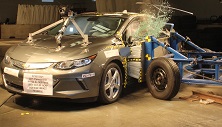
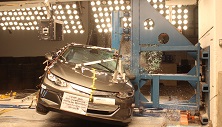
NHTSA 5-Star Safety Ratings (New Car Assessment Program). Ratings are comparable only between vehicles of similar size and weight, and ratings from 2011 on use tougher tests than earlier years. Photos: NHTSA.
Fuel economy
Volt Plug-in Hybrid
| City / highway | 43 / 42 mpg |
|---|---|
| Electric range | 53 mi |
| On electricity | 106 MPGe · 31 kWh/100 mi |
| Fuel | Regular Gasoline |
1.5 L · 4 cyl · Automatic (variable gear ratios) · Front-Wheel Drive · about $1,600/year to fuel
EPA estimates from fueleconomy.gov for each engine and transmission sold. Annual cost is the EPA's estimate for 15,000 miles a year at its current fuel and electricity price assumptions. Your results will vary.
What owners report
| Problem area | Complaints | Typical mileage* |
|---|---|---|
| Electrical systemPropulsion system › Traction battery › Management system/energy control module (bms/becm); Propulsion system | 317 | 39,250 mi |
| Fuel/propulsion system | 236 | 31,150 mi |
| Power trainAutomatic transmission › Lever and linkage › Floor shift; Automatic transmission › Gear position indication (prndl) | 221 | 34,598 mi |
| Engine | 184 | 26,000 mi |
| Unknown or other | 114 | 33,250 mi |
| Vehicle speed control | 32 | 15,000 mi |
| Service brakes | 27 | 15,000 mi |
| SteeringLinkages › Rod › Relay › Connecting | 16 | 26,500 mi |
| Air bags | 12 | 33,774 mi |
| Forward collision avoidanceAdaptive cruise control; Automatic emergency braking | 11 | — |
| Electronic stability control (esc) | 9 | 21,000 mi |
| Engine and engine coolingExhaust system › Emission control › Gas recirculation valve (egr valve) | 5 | 60,000 mi |
*Median odometer reading when the problem happened, where owners gave one. One complaint can name several problem areas.
Recent owner complaints
- Engine
The contact owns a 2017 Chevrolet Volt. The contact stated that while driving at an undisclosed speed, the vehicle suddenly lost power. The check engine warning light illuminated, and the message "Propulsion Power Reduced" was displayed. The manufacturer was notified of the failure. The failure mileage was 124,000.
- Electrical system
The contact owns a 2017 Chevrolet Volt. The contact stated that on several occasions while driving at 65-70 MPH, the vehicle lost motive power or experienced reduced motive power. The "Reduced Propulsion" message displayed, and the check engine warning light illuminated. Additionally, upon parking, the "Shift to Park" message displayed, causing the vehicle to fail to turn off until the contact pressed and held the Engine Start/Stop button multiple times. A diagnostic trouble code for the battery energy control module (BECM) was retrieved. The vehicle was taken to the dealer but was not diagnosed. The contact associated the failure with Special Coverage: N232432680 (Battery Energy Control…
- Electrical system
My 2017 Chevrolet Volt, with 97,758 miles, experienced a failure that rendered the vehicle inoperable. The vehicle would not start or operate normally. The vehicle was taken to an authorized Chevrolet dealership for diagnosis. After several days, the dealership confirmed that the Battery Energy Control Module (BECM) had failed. The dealership quoted approximately $2,500 for replacement, including parts and labor. This failure presents a serious potential safety concern because BECM malfunctions can result in loss of propulsion, reduced power, or an inability to restart the vehicle, potentially leaving drivers stranded in unsafe locations. General Motors has previously recognized BECM…
- Fuel/propulsion system
I am reporting a suspected Battery Energy Control Module (BECM) failure in my 2017 Chevrolet Volt. My vehicle has experienced multiple symptoms consistent with the known BECM defect documented by General Motors, including intermittent failure to start, reduced propulsion power, and failure to operate on electric power despite the high-voltage battery being fully charged. When the vehicle did start, it would run using the gasoline engine instead of the fully charged battery. The vehicle also experienced reduced propulsion power, limiting acceleration and creating a serious safety concern, particularly when merging into traffic, crossing intersections, or driving at highway speeds. The…
- Electrical system
2017 Chevy Volt, lost propulsion and stalled on a highway in 3 separate instances. GM Case # XXX: The first instance, in late 2021, resulted in a BECM replacement. The following instances, XXX and SXXX, had the exact same symptoms: loss of propulsion on highway, shift to park, full charge but 0 range, check engine light. GM Case # XXX: In March the vehicle was towed to Haselwood Chevrolet in [XXX] and they told to check for BECM issues. The dealership refused to include the customer description of the failure on the highway, or acknowledge there was a possible BECM issue, since they said there was no BECM code. The failure presented as a classic intermittent BECM thermal failure. They…
- Unknown or other
I would like to file a formal complaint. 2017 Volt suffered an EVAP purge line hole due to the failure of the remedy applied under NHTSA Campaign ID 19V891000. Recall #N192273600 was completed on my vehicle in 2020 by installing a protective bumper. That bumper failed by shifting out of place, and the A/C line has now rubbed a hole completely through my EVAP purge pipeâthe exact failure the recall was designed to prevent. I called GM and asked for a Goodwill Policy adjustment, and they refused as my dealer had already offered me a $500 reduction to the repair. The total cost of the repair is over $2700.
- Engine
3rd failure of EGR valve (GM part 12691147, superseded by 19436521) on this vehicle. 10/10/2019 at 11,336 mi: Check Engine Light and Driver Information Center displayed "Loss of Propulsion" message; EGR valve diagnosed as cause and replaced by dealer under warranty at no cost. 11/2023 at approx. 30,000 mi: EGR valve failed again; dealer stated OEM part was no longer available from manufacturer due to supply shortage and installed a third-party replacement part; repair not covered, paid out of pocket. 8/26/2026 at 49,864 mi: EGR valve failed a third time; a used, refurbished part was sourced due to continued unavailability of a reliable new OEM part, with repair scheduled for 9/14/2026,…
- Electrical system1 injury
The contact owns a 2017 Chevrolet Volt. The contact stated that while driving approximately 50 MPH, the "Propulsion Power Reduced" and "Shift to Park" messages were intermittently displayed on the instrument panel. The vehicle lost automotive power and stalled, and the contact pulled over to the shoulder to avoid a crash. The failure had occurred on several occasions. The contact sustained emotional distress from the failure. The vehicle was towed back to the residence and then towed to a dealer to be diagnosed, and it was determined that the battery needed to be replaced. The vehicle was towed to an independent mechanic to be diagnosed, and it was determined that the battery energy control…
Owner complaints are submitted to NHTSA by the public and are not verified. Shown as filed (NHTSA removes personal details); long reports are shortened.
NHTSA defect investigations
- Loss of Motive Power due to the Battery Energy Control ModuleClosed
On November 29, 2023, the Office of Defects Investigations (ODI) opened PE23022 to investigate allegations of a loss of motive power, including a stall, reduced power state, and/or a no start condition due to the Battery Energy Control Module (BECM) in model year (MY) 2016-2019 Chevrolet Volt passenger car vehicles manufactured by General Motors (GM). The BECM is located within the high voltage electric vehicle (EV) battery pack and monitors the temperature, current, and voltage of the high voltage battery cell groups. GM stated that the root cause was identified as an internal failure leading to a loss of communication within the BECM and does not pose a risk to motor vehicle safety. GM further stated that the failure cannot result in a complete stall, only a reduced power mode, no start condition, or a no charge condition. GM additionally stated that if these conditions occur, the…
- Pedestrian alert soundsClosedLed to recall 22V063000
NHTSA received a petition on or about July 18, 2022, requesting that Federal Motor Vehicle Safety Standard (FMVSS) 141 be applied to all electric and hybrid vehicles operating in the United States. The petition can be reviewed at NHTSA.gov under ODI Number 11486072. FMVSS 141 establishes performance requirements for pedestrian alert sounds for motor vehicles. The standard applies to hybrid and electric vehicles that have a gross vehicle weight rating of 4,536 KG or less or are defined as low-speed vehicles. The standard became fully applicable to all such vehicles manufactured on or after March 1, 2021.On January 27, 2023, NHTSA opened Defect Petition (DP) 22-005 to evaluate the subject matter described in the petition. On June 24, 2023 and as supplemented on June 25, 2023, the petitioner notified NHTSA he was withdrawing his petition. The petitioner indicated that, based on his review…