The 2017 Ford Edge has 8 safety recalls and 1,377 owner complaints on file with NHTSA. The most-reported problem area is engine (703 complaints).
Recalls8safety recalls
Complaints1,377filed by owners
Crashes · fires26 · 1reported in complaints
Injuries · deaths26 · 0reported in complaints
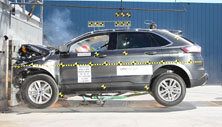
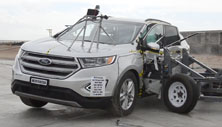
2017 Ford Edge in an NHTSA crash test
Safety recalls
Back over prevention › Sensing system › Camera
NHTSA recall 25V572000 · Sep 3, 2025 · 1,456,417 vehicles · opened after NHTSA action (ODI)
Problem: Ford Motor Company (Ford) is recalling certain 2015-2019 Lincoln MKC, Mustang, F-350 SD, F-250 SD, F-450 SD, 2015-2017 Lincoln Navigator, Expedition, 2015-2018 Edge, Transit Connect, 2016-2019 F-550 SD, Transit, 2017-2019 Econoline, and 2019 Ranger vehicles. The rearview camera may display a distorted, inverted, or blank image when the vehicle is in reverse.
Risk: A rearview camera that displays an inverted, distorted, or blank image can reduce the driverâs view behind the vehicle, increasing the risk of a crash.
Fix: Dealers will inspect and replace the rearview camera as necessary, free of charge. Owner notification letters were mailed January 13, 2026. Ford owners will receive letters in phases, beginning January 2026 and June 2026. Owners may contact Ford customer service at 1-866-436-7332. Ford's number for this recall is 25S89. This recall expands previous NHTSA recall number 25V270. Vehicle Identification Numbers (VINs) involved in this recall will be searchable on NHTSA.gov beginning September 8, 2025.
Service brakes, hydraulic › Foundation components › Hoses, lines/piping, and fittings
NHTSA recall 25V544000 · Aug 22, 2025 · 499,129 vehicles · opened after NHTSA action (ODI)
Problem: Ford Motor Company (Ford) is recalling certain 2016-2018 Lincoln MKX and 2015-2018 Edge vehicles. The rear brake jounce hose may rupture and leak brake fluid.
Risk: A brake fluid leak can extend the distance required to stop the vehicle, increasing the risk of a crash.
Fix: Dealers will inspect and replace the brake jounce hoses and adjust brake jounce hoses with no damage present, free of charge. Owner notification letters were mailed September 17, 2026. Owners may contact Ford customer service at 1-866-436-7332. Ford's number for this recall is 25S87.
Power train › Shift linkage/cable/rod
NHTSA recall 22V413000 · Jun 10, 2022 · 2,925,968 vehicles
Problem: Ford Motor Company (Ford) is recalling certain 2013-2019 Escape, 2013-2018 C-Max, 2013-2016 Fusion, 2013-2021 Transit Connect, and 2015-2018 Edge vehicles. The bushing that attaches the shifter cable to the transmission may degrade or detach.
Risk: A damaged or missing bushing may prevent the vehicle from shifting into the intended gear, and cause the vehicle to move in an unexpected direction. Additionally, the vehicle may roll after the driver selects the 'Park' position. Either scenario increases the risk of a crash or injury.
Fix: Dealers will replace the under hood shift bushing and add a protective cap over the shift cable bushing, free of charge. Interim owner notification letters, informing owners of the safety risk, were mailed July 1, 2022. Remedy parts are expected to be available in 4th Quarter 2022. Owner notification letters were mailed October 27, 2022. Owners may contact Ford customer service at 1-866-436-7332. Ford's number for this recall is 22S43.
Components: Power train › Shift linkage/cable/rod; Power train › Automatic transmission › Gear position indication (prndl)
Service brakes
NHTSA recall 20V469000 · Aug 10, 2020 · 488,594 vehicles
Problem: Ford Motor Company (Ford) is recalling certain 2015-2018 Ford Edge and 2016-2018 Lincoln MKX vehicles. The front brake hoses may rupture prematurely.
Risk: A ruptured front brake hose will cause a brake fluid leak, lengthening the distance needed to stop the vehicle, increasing the risk of a crash.
Fix: Ford will notify owners, and dealers will replace the front brake hoses with the new hoses that have a revised braid material, free of charge. Owner notification letters were mailed on May 13, 2021. Owners may contact Ford customer service at 1-866-436-7332. Ford's number for this recall is 20S42.
Components: Service brakes; Service brakes, hydraulic › Foundation components › Hoses, lines/piping, and fittings
Power train › Automatic transmission › Torque converter
NHTSA recall 18V390000 · Jun 11, 2018 · 25 vehicles
Problem: Ford Motor Company (Ford) is recalling certain 2017-2018 Ford Edge and 2017 Lincoln MKZ vehicles. On vehicles with 2.0L gas engines and six-speed automatic transmissions, the torque converter weld studs may have been inadequately welded.
Risk: If the torque converter weld studs fail, the torque converter will not be connected to the engine flexplate and the vehicle will lose the ability to move, increasing the risk of a crash.
Fix: Ford will notify owners, and dealers will replace the torque converters, free of charge. The recall began on July 5, 2018. Owners may contact Ford customer service at 1-866-436-7332. Ford's number for this recall is 17S16 (S2). Note: This recall is an expansion of recall 17V-427.
Power train › Automatic transmission › Torque converter
Problem: Ford Motor Company (Ford) is recalling certain 2017 Lincoln MKZ and Ford Edge and Fusion vehicles. On vehicles with 2.0L gas engines and six-speed automatic transmissions, the torque converter weld studs may have been inadequately welded.
Risk: If the torque converter weld studs fail, the torque converter will not be connected to the engine flexplate and the vehicle will lose the ability to move, increasing the risk of a crash.
Fix: Ford or Lincoln will notify owners, and dealers will replace the torque converters, free of charge. The recall began August 25, 2017. Owners may contact Ford customer service at 1-866-436-7332. Ford's number for this recall is 17S16.
Structure › Body › Roof and pillars
NHTSA recall 17V205000 · Mar 27, 2017 · 84 vehicles
Problem: Ford Motor Company (Ford) is recalling certain 2017 Edge vehicles equipped with the optional Panoramic Vista Roof. These vehicles may have an improperly welded windshield header, reducing the vehicle's lateral structural integrity. As such, these vehicles fail to comply with the requirements of Federal Motor Vehicle Safety Standard (FMVSS) number 214, "Side Impact Protection."
Risk: If the vehicle has reduced lateral structural integrity, the occupants are at an increased risk of injury in the event of a side-impact crash.
Fix: Ford will notify owners, and dealers will repair the windshield header, free of charge. The recall began May 18, 2017. Owners may contact Ford customer service at 1-866-436-7332. Ford's number for the recall is 17C05.
Air bags › Frontal › Driver side › Inflator module
NHTSA recall 17V123000 · Feb 27, 2017 · 27,531 vehicles
Problem: Ford Motor Company (Ford) is recalling certain 2016-2017 Ford Edge and Lincoln MKX vehicles and 2017 Lincoln Continental vehicles. In the event of a crash, the driver's frontal air bag may not fully inflate or the air bag cushion may detach from the air bag module. As such, these vehicles fail to comply with the requirements of Federal Motor Vehicle Safety Standard (FMVSS) number 208, "Occupant Crash Protection."
Risk: During deployment, if the air bag does not fully inflate or the cushion detaches, there is an increased risk of injury in the event of a crash.
Fix: Ford will notify owners, and dealers will replace the driver frontal air bag module, free of charge. The recall began June 16, 2017. Owners may contact Ford customer service at 1-866-436-7332. Ford's number for this recall is 17C02.
Recall repairs are free at any authorised dealer. A recall listed here may already have been fixed on a particular car: enter its 17-character VIN at nhtsa.gov/recalls to see open recalls.
Crash test ratings
NHTSA side barrier crash testNHTSA side pole crash test
2017 Ford Edge SUV AWD
Overall
★★★★★
Frontal crash
★★★★★
Side crash
★★★★★
Rollover
★★★★★
Rollover risk
15.5%
Forward collision warning: Optional · Lane departure warning: Optional
2017 Ford Edge SUV FWD
Overall
★★★★★
Frontal crash
★★★★★
Side crash
★★★★★
Rollover
★★★★★
Rollover risk
15.4%
Forward collision warning: Optional · Lane departure warning: Optional
NHTSA 5-Star Safety Ratings (New Car Assessment Program). Ratings are comparable only between vehicles of similar size and weight, and ratings from 2011 on use tougher tests than earlier years. Photos: NHTSA.
Fuel economy
Edge FWD
24mpg combined
City / highway
20 / 29 mpg
Fuel
Regular Gasoline
2 L · 4 cyl · Automatic (S6) · Front-Wheel Drive · about $2,800/year to fuel
Edge FWD
24mpg combined
City / highway
21 / 29 mpg
Fuel
Regular Gasoline
2 L · 4 cyl · Automatic (S6) · Front-Wheel Drive · about $2,800/year to fuel
Edge AWD
23mpg combined
City / highway
20 / 27 mpg
Fuel
Regular Gasoline
2 L · 4 cyl · Automatic (S6) · All-Wheel Drive · about $2,900/year to fuel
Edge FWD
20mpg combined
City / highway
17 / 26 mpg
Fuel
Regular Gasoline
3.5 L · 6 cyl · Automatic (S6) · Front-Wheel Drive · about $3,350/year to fuel
Edge AWD
20mpg combined
City / highway
17 / 24 mpg
Fuel
Regular Gasoline
2.7 L · 6 cyl · Automatic (S6) · All-Wheel Drive · about $3,350/year to fuel
Edge AWD
19mpg combined
City / highway
17 / 24 mpg
Fuel
Regular Gasoline
3.5 L · 6 cyl · Automatic (S6) · All-Wheel Drive · about $3,550/year to fuel
EPA estimates from fueleconomy.gov for each engine and transmission sold. Annual cost is the EPA's estimate for 15,000 miles a year at its current fuel and electricity price assumptions. Your results will vary.
What owners report
Problem area
Complaints
Crashes
Fires
Injuries
Typical mileage*
Engine
703
0
1
0
70,000 mi
Engine and engine cooling Cooling system; Exhaust system
266
0
0
0
75,054 mi
Power train Automatic transmission; Automatic transmission › Lever and linkage › Floor shift
148
2
0
1
74,030 mi
Service brakes
124
11
0
9
55,850 mi
Service brakes, hydraulic Foundation components › Hoses, lines/piping, and fittings; Foundation components › Master cylinder
110
2
0
0
90,000 mi
Unknown or other
83
4
0
3
47,220 mi
Back over prevention Sensing system › Camera; Rearview system braking
44
1
0
4
90,000 mi
Fuel/propulsion system
30
0
0
0
21,000 mi
Electrical system Propulsion system › Traction battery › Thermal management › Hoses, fittings, and reservoir; 12v/24v/48v battery
27
1
0
0
5,308 mi
Structure Body; Body › Hatchback/liftgate
26
2
0
3
37,500 mi
Steering Electric power assist system; Automated/adaptive steering
25
2
0
1
47,000 mi
Wheels Lugs/nuts/bolts/studs
17
0
0
0
—
*Median odometer reading when the problem happened, where owners gave one. One complaint can name several problem areas.
Recent owner complaints
Oct 22, 2026Electrical system At approximately 7:00 a.m. on 10/22/2026 I was driving my 2017 Ford Edge when suddenly there was a loud bang towards the rear of my car. Immediately after, I could hear my rear window shattering, cracking. There were no other cars near me at the time. As I continued to drive, the glass continued to crack and shatter. Glass started to break completely free from my window, and fall inside my rear hatch, as well as on the outside of the car on the road.
Sep 24, 2026Engine I am currently dealing with the coolant intrusion into cylinder 2 of the 2.0L EcoBoost engine. In the beginning of XXX at about 134K miles, the check engine light came on. I was at a stop light (.2 miles from my home) and I got a warning message telling me the coolant temp was high and engine power was reduced. When I got home, I saw that the coolant was low, but there has not been any leaks noticed in driveway, refilled and was fine for 2 weeks. During those 2 weeks, I was having a rough idle at start up, and white smoke coming from exhaust. Then on the way to work the engine was overheating. Pulled over and turned off on the side of a highway to let it cool. After 10 minutes, turned the…
Jul 19, 2024Engine My 2017 Ford Edge SEL, equipped with a 1.5L EcoBoost engine, experienced a catastrophic engine failure at 66,897 miles due to coolant intrusion into the engine cylinders â a defect Ford Motor Company had already identified and documented in Technical Service Bulletin TSB 22-2229, issued in 2022. Warning symptoms: The check engine light began flashing accompanied by a rough cold start, noise on startup, and engine misfiring. These symptoms appeared suddenly and without prior indication of any mechanical issue. Component that failed: The 1.5L EcoBoost engine â specifically, coolant intrusion into the cylinder(s) caused by a known manufacturing defect. The failed long block engine is…
Sep 28, 2026Engine The component that has failed is the engine and it is available for inspection. The vehicle on multiple occasions has had loss of power while driving. The most recent incident was when I was driving 100 miles on interstate 81 and could not go more then 60 miles an hour. I had multiple semis and vehicles that had to go around me as the speed limit was 70. It also had severe loss of power going over mountains to go home. It also would shudder upon starting up and constantly lost antifreeze. I took the vehicle to Stuckey ford Bellefonte service shop and they confirmed coolant leaking into cylinder 2 and that it needed a new engine. They performed a multi-point vehicle inspection and a visual…
Sep 21, 2026Engine 2017 Ford Edge 2.0L EcoBoost with 114,500 miles. Permanent P0303 code due to documented engine block coolant intrusion defect.
Oct 1, 2025Engine My 2017 ford edge titanium 2.0 ecoboost has lost power and my coolant warning goes on. My check engine light stays on OBD scanner states p0301 cylinder one misfire. I have taken the spark plug out of cylinder 1 and did a coolant compression test and can clearly see coolant leaking onto cylinder 1. I do have a video of this as well.
Sep 7, 2026Engine I am currently dealing with the coolant intrusion into cylinder 2 of the 2.0L EcoBoost engine. In the beginning of XXX at about 125K miles, the check engine light came on. I was at a stop light (.2 miles from my home) and I got a warning message telling me the coolant temp was high and engine power was reduced. When I got home, I saw that the coolant was low, but there has not been any leaks noticed in driveway, refilled and was fine for 2 weeks. During those 2 weeks, I was having a rough idle at start up, and white smoke coming from exhaust. Then on the way to work the engine was overheating. Pulled over and turned off on the side of a highway to let it cool. After 10 minutes, turned the…
Aug 24, 2026Engine I am reporting a loss-of-coolant and rough-running condition consistent with coolant intrusion into the cylinders, the defect described in Ford TSBs 19-2208, 19-2346, 22-2133, and 22-2229, and the subject of NHTSA defect petition DP26008. The engine has unexplained coolant loss with no visible external leak. It also has a rough start. A stored diagnostic code was present; I believe it was P0302, signalling a misfire in cylinder 2 and P0316, signaling misfire detected on start up. No crash, fire, or injury. I am reporting before a total loss of power because these failures are described as occurring while driving. In August, I brought the vehicle into my local Ford dealer for an oil change,…
Owner complaints are submitted to NHTSA by the public and are not verified. Shown as filed (NHTSA removes personal details); long reports are shortened.
NHTSA defect investigations
DP26008 · opened Sep 3, 2026 · openLoss of Motive Power The Office of Defects Investigation (ODI) received a petition on August 5, 2026, requesting a defect investigation into the 2.0 Liter EcoBoost engine on model year 2015-2018 Ford Edge vehicles. The petition alleges that engine coolant intrusion results in a significant loss of engine power, accompanied by an "Engine Coolant Over Temperature" warning message. The petition further alleges that after the vehicle has sat and cooled down, the engine runs roughly and generates a check engine light for a cylinder misfire. This defect petition is being opened to evaluate the issue and determine whether to grant or deny the petition. The petition can be reviewed at NHTSA.gov under ODI number 11754989.
PE24027 · opened Oct 3, 2024 · closed Oct 30, 2025 · led to recall 25V544Loss of braking caused by rear brake hose failure On October 3, 2024, NHTSAâs Office of Defects Investigation (ODI) opened this Preliminary Evaluation to investigate instances of rear brake hose ruptures causing a sudden and unexpected loss of braking in model year (MY) 2015-2017 Ford Edge vehicles manufactured by Ford Motor Company. The complaints allege that, without warning, the vehicle lost its ability to brake causing an unanticipated increase in the vehicleâs stopping distance. The complaints also allege that, prior to the rear brake hose rupture event, the vehicle had been serviced under recall 20V-469. Recall 20V469 involved MY 2015-2018 Ford Edge and MY 2016-2018 Lincoln MKX vehicles which may experience front brake hose ruptures causing increased brake pedal travel and a reduction in the rate of deceleration. Ford identified the cause of this safety defect as a consistent localized failure of the internal reinforcement…
EA21002 · opened Sep 17, 2021 · openDesiccated Air Bag Inflator Rupture From 2000 through 2017, Takata produced millions of air bag inflators using two types of phase-stabilized ammonium nitrate ("PSAN") propellant -- propellant 2004 and propellant 2004L. After prolonged exposure to high temperature cycles and humidity, inflators using propellant 2004 can degrade, causing the propellant to burn too quickly when ignited. The rapid burning can cause the inflator to rupture during deployment, potentially causing serious or even fatal injury to vehicle occupants. See 2016 Blomquist Report at www.nhtsa.gov/sites/nhtsa.gov/files/documents/expert_report-hrblomquist.pdf.Consequently, all frontal inflators using propellant 2004 that do not contain a "desiccant" (a substance that traps and holds moisture) in US vehicles are under recall. These "non-desiccated" inflators either have been or are required to be replaced.In some cases, the remedy part for these recalled…