Problem: Hyundai Motor America (Hyundai) is recalling certain 2015-2017 Sonata, 2016-2017 Sonata Hybrid, and Sonata Plug-In Hybrid vehicles. The Smart Junction Box (SJB) software logic may not properly interpret the signals received from the multifunction switch, which could cause the turn signal to activate in the opposite direction of what the driver intended.
Risk: A turn signal that activates in the opposite direction of what was intended by the driver increases the risk of a crash.
Fix: Dealers will update the SJB software, free of charge. Owner notification letters were mailed November 19, 2021. Owners may contact Hyundai customer service at 1-855-371-9460. Hyundai's number for this recall is 210.
Components: Electrical system › Software; Exterior lighting › Turn signal
Parking brake › Indicator light
NHTSA recall 17V359000 · Jun 5, 2017 · 161,074 vehicles
Problem: Hyundai Motor America (Hyundai) is recalling certain 2015-2016 Sonata and Genesis vehicles. In the affected vehicles, the warning light to indicate that the parking brake is applied may intermittently not illuminate in the dash due to corrosion in the switch.
Risk: If the parking brake indicator is not illuminated when the parking brake is applied, the driver may operate the vehicle with the parking brake partially engaged, increasing the risk of a crash.
Fix: Hyundai will notify owners, and dealers will replace the parking brake switch, free of charge. The recall began on August 4, 2017. Owners may contact Hyundai customer service at 1-855-671-3059. Hyundai's number for this recall is 164.
Visibility › Sun/moon roof assembly
NHTSA recall 16V726000 · Oct 11, 2016 · 62,811 vehicles
Problem: Hyundai Motor America (Hyundai) is recalling certain model year 2015-2016 Sonata Hybrid vehicles manufactured December 8, 2014, to August 18, 2015, and Hyundai Sonata vehicles manufactured May 28, 2014, to March 18, 2016, equipped with the panoramic sunroof option. Due to a bonding issue with the sunroof wind deflector, the sunroof panel on the affected vehicles may detach while driving.
Risk: If the sunroof detaches from the vehicle it could become a road hazard, increasing the risk of a crash.
Fix: Hyundai will notify owners, and dealers will repair the wind deflector anchor plate, free of charge. The recall began December 2016. Owners may contact Hyundai customer service at 1-800-633-5151. Hyundai's number for this recall is 152.
Air bags
NHTSA recall 16V615000 · Aug 24, 2016 · 1,031 vehicles
Problem: Hyundai Motor Company (Hyundai) is recalling certain model year 2016 Sonata vehicles manufactured March 28, 2016 through April 12, 2016. The affected vehicles have a driver-side frontal air bag that may not adequately protect the driver's neck from injury in the event of a crash. As such, these vehicles fail to comply with the requirements of Federal Motor Vehicle Safety Standard (FMVSS) number 208, "Occupant Crash Protection."
Risk: A frontal air bag that does not adequately protect the driver's neck may increase their risk of injury in the event of a crash.
Fix: Hyundai will notify owners, and dealers will replace the driver's frontal air bag module, free of charge. The recall began October 14, 2016. Owners may contact Hyundai customer service at 1-800-633-5151. Hyundai's number for this recall is 148.
Problem: Hyundai Motor Company (Hyundai) is recalling certain model year 2015-2016 Sonata vehicles manufactured May 29, 2014 to February 11, 2016, 2017 Elantra vehicles manufactured January 12, 2016 to February 22, 2016, and one 2016 Sonata Hybrid vehicle manufactured October 15, 2015. In these vehicles, the driver's frontal air bag may be missing a chemical enhancer required for the second stage air bag deployment, resulting in the second stage not deploying in certain crashes. The primary stage will deploy as intended.
Risk: An air bag that does not inflate increases the risk of injury.
Fix: Hyundai will notify owners, and dealers will replace the driver's frontal air bag module, free of charge. The recall began on May 5,2016. Owners may contact Hyundai customer service at 1-855-371-9460. Hyundai's number for this recall is 144.
Electrical system › Instrument cluster/panel
NHTSA recall 15V678000 · Oct 20, 2015 · 64,744 vehicles
Problem: Hyundai Motor America (Hyundai) is recalling certain model year 2015-2016 Sonata vehicles manufactured May 28, 2014, to August 21, 2015. The affected vehicles are equipped with an Antilock Braking System (ABS) warning light intended to warn the driver if there is an ABS malfunction. In the event of an ABS malfunction, the Brake System warning light will illuminate, but the ABS warning light will not illuminate. Since the vehicles have ABS malfunction lights that do not illuminate, these vehicles fail to comply with the requirements of Federal Motor Vehicle Safety Standard (FMVSS) number 135, "Light Vehicle Brake Systems."
Risk: If the driver is alerted there is a brake system malfunction, but not specifically with the ABS system, the driver may operate the vehicle unaware that the vehicle's brakes may lock up during hard braking, increasing the risk of a crash.
Fix: Hyundai will notify owners, and dealers will update the ABS control unit software, free of charge. The recall is expected began on November 30, 2015. Owners may contact Hyundai customer service at 1-855-671-3059. Hyundai's number for this recall is 134.
Recall repairs are free at any authorised dealer. A recall listed here may already have been fixed on a particular car: enter its 17-character VIN at nhtsa.gov/recalls to see open recalls.
Crash test ratings
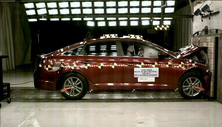
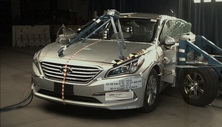
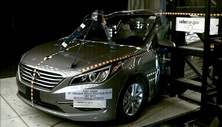
NHTSA side barrier crash testNHTSA side pole crash test
2016 Hyundai Sonata 4 DR FWD
Overall
★★★★★
Frontal crash
★★★★★
Side crash
★★★★★
Rollover
★★★★★
Rollover risk
10.5%
Forward collision warning: Optional · Lane departure warning: Optional
2016 Hyundai Sonata Plug-in Hybrid 4 DR FWD
Overall
Not Rated
Frontal crash
Not Rated
Side crash
Not Rated
Rollover
Not Rated
Forward collision warning: Optional · Lane departure warning: Optional
NHTSA 5-Star Safety Ratings (New Car Assessment Program). Ratings are comparable only between vehicles of similar size and weight, and ratings from 2011 on use tougher tests than earlier years. Photos: NHTSA.
Fuel economy
Sonata
31mpg combined
City / highway
28 / 36 mpg
Fuel
Regular Gasoline
1.6 L · 4 cyl · Automatic (AM7) · Front-Wheel Drive · about $2,150/year to fuel
Sonata
29mpg combined
City / highway
25 / 36 mpg
Fuel
Regular Gasoline
2.4 L · 4 cyl · Automatic (S6) · Front-Wheel Drive · about $2,300/year to fuel
Sonata Sport Limited
28mpg combined
City / highway
25 / 35 mpg
Fuel
Regular Gasoline
2.4 L · 4 cyl · Automatic (S6) · Front-Wheel Drive · about $2,400/year to fuel
Sonata
26mpg combined
City / highway
22 / 31 mpg
Fuel
Regular Gasoline
2 L · 4 cyl · Automatic (S6) · Front-Wheel Drive · about $2,600/year to fuel
Sonata Limited
24mpg combined
City / highway
21 / 30 mpg
Fuel
Regular Gasoline
2 L · 4 cyl · Automatic (S6) · Front-Wheel Drive · about $2,800/year to fuel
EPA estimates from fueleconomy.gov for each engine and transmission sold. Annual cost is the EPA's estimate for 15,000 miles a year at its current fuel and electricity price assumptions. Your results will vary.
What owners report
Problem area
Complaints
Crashes
Fires
Injuries
Typical mileage*
Engine
452
1
19
0
82,500 mi
Electrical system Ignition › Anti-theft › Immobilizer/proximity › Key/sender; Cybersecurity
*Median odometer reading when the problem happened, where owners gave one. One complaint can name several problem areas.
Recent owner complaints
Apr 20, 2026 · 70,000 milesEngine and engine cooling The contact owns a 2016 Hyundai Sonata. The contact stated that while getting an oil change, the contact was informed that the oil pan was empty. The contact could not recall seeing leaks or making changes to the oil change routine. An independent mechanic informed the contact of an engine recall regarding excessive oil consumption. The contact was referred to the dealer. The contact had the oil inspected twice more and was informed of low oil levels on each occasion, but there were no leaks or burning oil odors. The vehicle was taken to the dealer, where it was confirmed that no open recall was associated with the VIN. The dealer replaced several sensors; however, the contact was unable to…
Jun 20, 2026 · 60,436 milesEngine The contact owns a 2016 Hyundai Sonata. While the contact's daughter was driving 55 MPH, the engine seized. The contact stated that the failure had occurred while the contact's two minor grandchildren were inside the vehicle during the failure. The vehicle was towed to an independent mechanic. The vehicle was later towed to the dealer where it was diagnosed with engine failure. The contact was informed that the engine needed to be replaced. The manufacturer was contacted, and a case was filed. The contact was informed about the eligibility for the extended warranty under Campaign 953. The contact was informed that the repair was not covered under the extended warranty because the Campaign…
Oct 3, 2026Engine While driving on the freeway, the check engine light started flashing and the gas pedal became useless. This put the driver and the passenger of the car in massive danger as they could no longer accelerate on the freeway. Luckily, they were able to get off the freeway without causing an accident. Upon reading the code at an auto shop, they discovered that it was P1326 or a knock sensor issue. This malfunction caused the car to go into limp mode and put the passengers in serious danger. Several calls to the Hyundai Service Center were made yesterday (Saturday, October 3rd). However, not one was ever answered. They hope to be able to get the car to the dealership's service center as soon as…
Jan 1, 2025Electrical system Backup vision system failed. Couldn't see vision because screen was blank. Radio didn't work either. Went to dealership with the problem they said it was not covered by the warranty. Paid to have it fixed.
Sep 15, 2026Engine I am concerned that the engine may seize or stall without warning while driving, creating a risk of crash, injury, or death. The Theta II engine defect is known to cause engine seizure, stalling, and fire. Hyundai has denied warranty coverage based on mileage and second-owner status â both of which are explicitly prohibited as denial grounds under the Settlement â leaving me driving an unsafe vehicle.
Aug 7, 2026Engine The vehicle experienced a Theta II engine failure at under 57,830 miles while driving on northbound [XXX] near the [XXX] Parkway U-turn in [XXX]. The engine made a loud noise and lost power. I was able to coast to the far right side of the U-turn under the bridge. I called HERO (Austin's emergency roadside assistance). They responded, determined it was not a battery issue, and pushed the vehicle to the Southern Leisure Spa parking lot on the southbound side of the road. The vehicle was then towed. The vehicle is equipped with the KSDS (Knock Sensor Detection System) software update, installed as part of Hyundai's remedy for this known defect. Despite KSDS being installed, the engine failed…
Aug 20, 2026Engine The car died while going 70 on a highway with no warning signs. The car completely shut off and will not turn over or move at all.
Jul 27, 2026Engine Component & Inspection: Vehicle engine suffered connecting rod bearing failure and entered restricted P1326 "Limp Home Mode" (max 2,000 RPM). The vehicle is grounded and available for inspection at Bud Clary Hyundai in [XXX].Safety Risk: Sudden, unexpected loss of power occurred while driving, placing me and other drivers at immediate risk on public roads due to the vehicle's inability to maintain normal traffic speed or safely accelerate.Dealer & Corporate Confirmation: Active P1326 engine code is confirmed. Car has been held for 14 days. The franchise is violating federal settlement rules by explicitly refusing to execute the mandatory, free mechanical Bearing Clearance Test (BCT) unless…
Owner complaints are submitted to NHTSA by the public and are not verified. Shown as filed (NHTSA removes personal details); long reports are shortened.
NHTSA defect investigations
DP22003 · opened Sep 12, 2022 · closed Dec 12, 2023Loss of Motive Power The National Highway Traffic Safety Administration (NHTSA) received a letter dated July 13, 2022, petitioning the Agency to initiate a safety defect investigation into loss of motive power allegations attributed to oil drain pan assembly failures on certain Hyundai Motor America, Inc. and Kia America, Inc. vehicles spanning Model Years (MY) 2005-2021. The Petitioners cited examples of complaints indicating that the subject vehicles were experiencing rapid loss of engine oil due to oil drain plug back outs, resulting in loss of motive power and/or catastrophic engine damage. Additional complaints were provided which alleged that the oil drain pans lack sufficient structural integrity and are susceptible to cracking. The petition itself can be reviewed at NHTSA.gov under ODI number 11481745. On September 12, 2022, the Office of Defects Investigation (ODI) opened Defect Petition (DP22-003)…
EA21003 · opened Dec 22, 2021 · closed Feb 5, 2024 · led to recall 23V877Engine Fires On March 29, 2019, the Office of Defects Investigation (ODI) opened two Preliminary Evaluations (PE19-003 on Hyundai and PE19-004 on Kia) to broadly investigate incidents of non-crash fires (regardless of origin or operational status of the vehicle) on various model year Hyundai and Kia vehicles. During the PE investigations, Hyundai and Kia issued several recalls to address vehicle fires, including those due to engine failures involving various engine types. The remedies for the engine failure recalls typically involve engine inspection (to detect existing damage), and if necessary, engine replacement. Additionally, both manufacturers have been installing an engine control software modification known as Knock Sensor Detection Software (KSDS) which is intended to detect impending engine failure, alert the driver, and limit engine power (to lessen likelihood of engine failure).KSDS is…
EA19001 · opened Apr 19, 2019 · closed Sep 19, 2024 · led to recall 20V024Electrical overstress The Office of Defects Investigation (ODI) opened this investigation to determine if the failure of airbags to deploy during severe crashes, in certain vehicles, was the result of a safety related defect. During the investigation a complex failure was studied that can result in non-deployment of subject vehicle air bags and other restraint system devices in severe crash events. The subject vehicles may be equipped with an airbag control unit (ACU) for the supplemental restraint system (SRS) Electronic Control Unit (ECU) manufactured by ZF-TRW.  The ECU receives signals from crash sensors mounted in the vehicle and deploys the vehicle air bags and seat belt pretensioners in accordance with manufacturer design specifications.  The ECU in the subject vehicles contains a model DS84 application-specific integrated circuit (ASIC) which controls the communication of the crash sensor signal,…
PE16010 · opened Sep 3, 2016 · closed Feb 22, 2017Electronic Parking Brake The Office of Defects Investigation opened this investigation on September 3, 2016 based on four reports alleging the rear brakes locked or applied while driving without brake pedal application. One of the reports alleged a fire in the right rear wheel area.The vehicles subject to the investigation are equipped with an optional Electronic Parking Brake (EPB). In this system, an electric motor applies the parking brake by moving the rear brake pads (pads) against the brake rotors (rotors) when activated by the EPB control switch. The EPB is released by the control switch or by selecting a drive gear with the transmission shifter when the ignition is on.If the EPB has not been used within 1000 kilometers (621 miles) the system is designed to perform an Automatic Adjustment Function (AAF) of the pads to check for proper clearance. This function is a pad adjustment only and is preformed…